
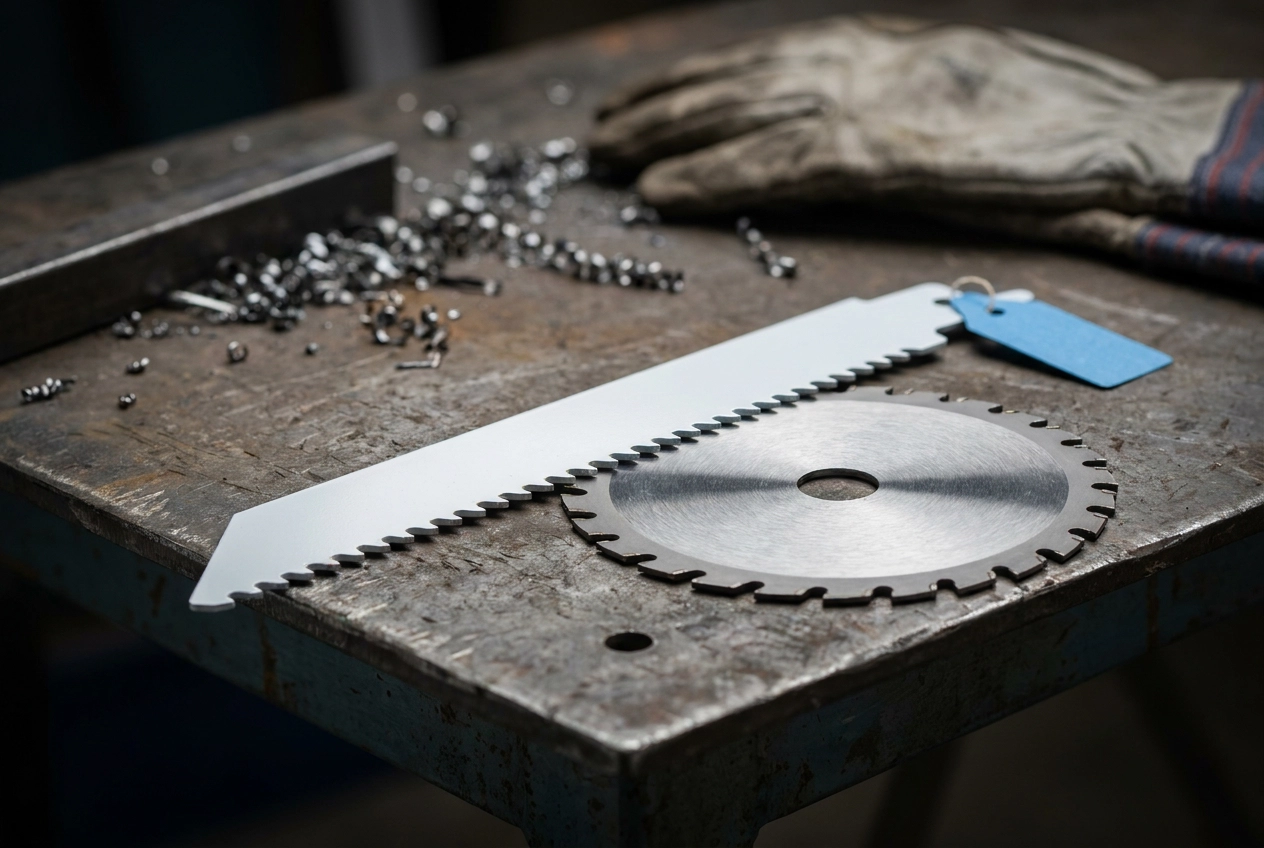
Choosing the right blade for metal cutting can mean the difference between a clean, efficient cut and a frustrating, time-consuming mess. Whether you’re working on structural steel, pipe fabrication, or demolition projects, understanding your cutting tools is essential for achieving professional results. Two of the most commonly debated options in metal cutting are reciprocating saw blades and cold saw blades, each with distinct mechanical principles and ideal use cases.
Reciprocating saw blades are a go-to choice for many tradespeople due to their versatility and portability, but they face serious competition from cold saw blades when precision and finish quality become priorities. So how do you know which one belongs in your toolkit for a specific job?
In this comparison, you’ll get a detailed breakdown of how both blade types function, their material compatibility, cutting speed, heat generation, and overall performance in real-world metal cutting scenarios. By the end, you’ll have a clear technical understanding of when to reach for one over the other, helping you make smarter decisions on the job site or in the shop.
What Are Reciprocating Saw Blades?
Reciprocating saw blades are consumable cutting accessories designed for use with reciprocating saws, a tool category built around a push-pull stroke mechanism that drives the blade forward and backward in rapid succession. The blade category spans four primary material types, each engineered for a specific performance envelope.
High Carbon Steel (HCS) blades, typically manufactured from alloys in the 1070–1095 grade range, are hardened and tempered to balance edge retention with flexibility. They perform well on wood, plastic, and soft materials but degrade quickly when applied to harder substrates. High-Speed Steel (HSS) blades retain their hardness at elevated temperatures, making them better suited to metal cutting applications where frictional heat is a persistent concern. Bi-Metal blades take a composite approach, welding hardened HSS cutting edges onto flexible spring-steel bodies. This construction reduces blade breakage while extending service life by 40–60% compared to standard carbon steel blades, making them the workhorse option across demolition, rough metal cutting, and mixed-material jobsite conditions. Carbide Grit blades use abrasive-edged construction for hard, brittle materials including cast iron, concrete, brick, and ceramic, where conventional tooth geometry would fail immediately.
Bi-Metal blades currently hold the largest material segment position, accounting for 41.3% of the global reciprocating saw blades market in 2025, which was valued at $1.82 billion and is projected to reach $3.04 billion by 2034 at a 5.9% CAGR. Their dominance reflects the reality of jobsite work: tradespeople and contractors rarely cut a single material in isolation. The ability to transition between wood framing, embedded nails, conduit, and sheet metal without changing blades is a genuine productivity advantage in demolition and renovation environments. North America leads the market with a 34.2% revenue share in 2025, consistent with the region’s high levels of construction and infrastructure renovation activity.
The reciprocating saw format offers three core operational strengths: portability, accessibility, and versatility. Cordless models allow cutting in confined or remote spaces where stationary equipment cannot reach. The tool’s open design enables blade entry into walls, floors, and tight corners. These characteristics make reciprocating saws well-suited for contractors, plumbers, electricians, and renovation crews performing field work.
However, the reciprocating action introduces fundamental mechanical limitations that matter significantly when dimensional accuracy or surface finish is required. The push-pull stroke mechanism generates friction heat through repetitive blade contact with the workpiece. This thermal buildup accelerates edge wear and can cause workpiece distortion on thinner metals. The aggressive, non-continuous cutting action also produces burrs along cut edges and introduces dimensional variability that is difficult to control consistently across multiple cuts. Unlike continuous rotary cutting, the stroke-based mechanism cannot maintain the stable tooth engagement geometry needed for tight tolerances.
For metal cutting specifically, reciprocating saw blades typically run in the 14 to 24 TPI range. Finer pitch configurations, toward the 18 to 24 TPI end, are used on thin-walled tubing and sheet metal to ensure multiple teeth remain in contact with the workpiece at any given moment, reducing tooth stripping and vibration. Coarser configurations in the 14 to 18 TPI range handle heavier structural sections. These TPI figures contrast sharply with cold saw blade tooth configurations, which use far fewer teeth distributed across large-diameter circular blades. Cold saw geometry is engineered for slow, lubricated cuts with controlled chip evacuation, minimal heat transfer to the workpiece, and repeatable dimensional accuracy, capabilities that fall outside the mechanical range of reciprocating saw technology regardless of blade material or tooth count.
What Are Cold Saw Blades?
Where reciprocating saws rely on a back-and-forth stroke to cut through material, cold saws operate on an entirely different mechanical principle. A cold saw uses a circular blade rotating at low RPM to cut metal, and that low-speed design is the foundation of everything that makes cold cutting technically distinct from other metal cutting methods.
How the Cutting Mechanism Works
The defining principle is chip load distribution. Rather than grinding material away at high speed, a cold saw blade engages the workpiece with multiple teeth simultaneously, each tooth taking a small, controlled bite. Heat generated at the cutting interface is transferred directly into the evacuated chips, which carry that thermal energy away from the cut zone as they are expelled. The result is that both the workpiece and the blade itself remain at or near ambient temperature throughout the cut. This is the mechanical basis for the term “cold cutting,” and it is not a marketing label. It is a description of a measurable thermal outcome that directly affects cut quality and material integrity.
For manufacturers working with stainless steel, high-alloy steels, or precision-tolerance components, this matters significantly. Conventional abrasive cutting methods produce heat-affected zones at the cut edge, which can alter the metallurgical properties of the material and introduce dimensional variance through thermal expansion. Cold saw cutting eliminates that risk. Cut surfaces are typically burr-free or near-burr-free, often requiring no secondary deburring before downstream processing. Dimensional accuracy is preserved because thermal expansion of the workpiece during the cut is negligible.
Blade Material Categories
Cold saw blades are available in several material configurations, each suited to specific cutting applications and production volumes. Solid HSS (M2 grade) is the standard workhorse for ferrous metals including mild steel and structural tubing, and its resharpening capability makes it economical over a full service life. TiAlN-coated HSS blades apply a titanium aluminum nitride surface treatment to the HSS substrate, extending blade life significantly in high-duty-cycle ferrous cutting. TiCN-coated HSS uses titanium carbonitride, which offers distinct friction and hardness characteristics suited to specific ferrous applications. Aluminum-specific blade designs use a different tooth geometry entirely, typically incorporating high positive rake angles and wider gullets to manage the gummy, stringy chips that non-ferrous metals produce. Understanding which blade material matches your cutting application is the first step in blade selection.
Size Range and the Diameter-RPM Relationship
Cold saw blades are available across a wide diameter range, from 2.5 inches up to 48 inches, covering applications from small-diameter tube cutting to large structural section work. Blade diameter directly governs the RPM required to maintain correct surface feet per minute at the cutting edge. A larger-diameter blade must rotate more slowly to keep tooth tip speed within the appropriate cutting range for a given material. Running a blade outside its correct SFPM range, either too fast or too slow, degrades cut quality and accelerates blade wear. This relationship is a practical engineering calculation, not an approximation.
Tooth Geometry as the Primary Selection Variable
Tooth geometry and configuration are the primary specification variables in cold saw blade selection, not secondary considerations. The governing rule is that at least three teeth must remain in contact with the workpiece at all times during a cut. Too few teeth in contact risks tooth breakage and vibration; too many teeth for a thick cross-section reduces chip clearance and causes re-cutting of chips, which negates the cold-cutting principle entirely. Rake angle, gullet depth, tooth pitch, and specialized tooth forms such as alternating bevel or triple chip geometries must all be matched to the material type, cross-section profile, and wall thickness being cut. Per the detailed breakdown of tooth selection principles, treating tooth geometry as an afterthought is one of the most common sources of premature blade failure and poor surface finish in cold saw operations.
Head-to-Head Comparison: 8 Criteria That Matter to Metal Fabricators
When metal fabricators evaluate cutting tools, the performance gap between reciprocating saws and cold saws becomes clearest through direct, criteria-based analysis. Each tool type has a defined operational envelope, and understanding where those envelopes diverge helps production shops make informed capital and consumable decisions.
Cut Quality and Burr Formation
Cold saws produce clean, square cuts with minimal or no burr in a single pass, a direct result of the low-RPM circular blade geometry and controlled chip formation. Reciprocating saws, by contrast, generate a tearing, stroking action that leaves irregular edges, micro-burrs, and surface roughness requiring deburring wheels, files, or secondary grinding operations before the part is fit-ready. In production environments where components move directly from the saw to welding fixtures or assembly jigs, eliminating that deburring step represents measurable labor savings per shift. For shops cutting structural tubing, DOM round stock, or angle iron at volume, the difference in finished edge quality between the two tool types is not marginal; it directly affects downstream cycle time.
Heat Generation and Material Integrity
The reciprocating action concentrates frictional energy at a narrow, repeatedly contacted cut zone, generating heat that can induce work-hardening in austenitic stainless steels, alter grain structure in heat-treated alloys, and accelerate blade dulling well before the blade reaches its theoretical service life. Cold saws transfer the heat of cutting almost entirely into the chip, which is evacuated away from the workpiece during the cut. This chip evacuation mechanism is the reason cold saws are named as such; the workpiece itself remains near ambient temperature throughout the operation. For fabricators cutting 304 or 316 stainless, this is a critical distinction, since work-hardening from excessive heat can make subsequent machining operations significantly more difficult and introduce residual stress into the finished part.
Dimensional Accuracy and Tolerances
Cold saws operating on rigid machine platforms with properly set vise clamps consistently hold tolerances in the range of plus or minus 0.005 inches on cut length and squareness, making them suitable for production fitment without secondary facing operations. Reciprocating saws introduce multiple sources of dimensional variance: blade flex under lateral load, operator path deviation, and the non-continuous cutting geometry that can cause the blade to wander in the kerf. For a one-off jobsite cut, that variance is acceptable. For a production run of 200 identical tube stanchions or structural weldments requiring consistent cope geometry, the accumulated variance from a reciprocating saw creates rework and scrap. Industry analysis of cold saw versus competing saw formats confirms that tolerance repeatability is a primary driver of cold saw adoption in production fabrication settings.
Blade Longevity and Cost Per Cut
TiAlN and TiCN-coated HSS cold saw blades represent a significant advance in blade longevity relative to uncoated HSS, with coating hardness values exceeding 3,000 HV providing a thermal and oxidation barrier that extends cutting edge life across high-cycle applications. A quality coated cold saw blade used in a properly maintained machine with correct RPM settings can deliver thousands of cuts on mild steel before requiring resharpening, and cold saw blades are resharpened rather than discarded, further amortizing the per-blade investment. Reciprocating blades, even bi-metal variants (which currently hold 41.3% of the reciprocating saw blade market by material type), are consumable and disposable; they are not designed for resharpening. When cost-per-cut is calculated across a production run at comparable material removal rates, the cold saw blade economics are consistently more favorable once volume exceeds a modest threshold.
TPI and Tooth Geometry Options
Cold saw blades are available in a broader range of engineered tooth configurations than reciprocating blades, including alternate tooth geometry for ferrous materials, triple chip geometry optimized for non-ferrous metals and aluminum alloys, and variable pitch profiles that reduce harmonic vibration on thin-wall tubing. These configurations are engineered to match specific material hardness, section geometry, and cut profile requirements. Reciprocating blades offer TPI selection in standard increments, generally ranging from 6 TPI for aggressive demolition cuts to 24 TPI for thin sheet metal, but the tooth geometry engineering depth available in cold saw formats is considerably greater. For shops cutting a diverse material mix including aluminum extrusions, structural steel, and stainless tubing, the ability to select a purpose-engineered cold saw tooth profile for each application translates directly into better surface finish and longer blade life.
Material Compatibility
Both tool types can cut ferrous and non-ferrous metals, but the distinction between ferrous and non-ferrous cold saw configurations highlights how engineered the cold saw tooling approach is relative to reciprocating formats. Aluminum, in particular, requires specific tooth geometry and cutting geometry to prevent chip welding and built-up edge formation; cold saw blades engineered for aluminum cutting address these failure modes directly. Stainless steel cutting with a reciprocating saw accelerates blade wear and risks the work-hardening effects described above. Structural steel and heavy-wall tubing are manageable with reciprocating saws in field conditions, but the cut quality and blade service life are meaningfully inferior to cold saw performance in a controlled shop environment.
Production Volume Suitability
Cold saws are purpose-designed for high-cycle, repeatable production environments where setup time is justified by run volume and every cut must meet the same dimensional and quality standard. Reciprocating saws are optimized for low-cycle, variable jobsite tasks where portability, setup speed, and access geometry matter more than precision or surface finish. Fabricators who have transitioned from abrasive or reciprocating tools to cold saws consistently describe the quality improvement as significant enough to change their downstream finishing workflow entirely. The two tool types are not directly competing in most real-world shops; they serve different operational contexts.
Total Cost of Ownership
When total cost of ownership is modeled across a production scenario, the cold saw advantage compounds across multiple cost categories simultaneously. Blade replacement frequency is lower, resharpening extends blade value rather than converting it to scrap, secondary finishing labor is reduced or eliminated, and dimensional consistency reduces rework and scrap rates. Reciprocating blades carry a lower unit acquisition cost, but their disposable nature, combined with the finishing labor they generate and the scrap risk from dimensional variance, erodes that initial price advantage rapidly at production scale. For fabricators evaluating the capital cost of a cold saw setup against ongoing reciprocating blade consumption and finishing labor, the crossover point where cold saw economics become favorable typically arrives well before the end of the first year of production use.
When a Reciprocating Saw Is the Right Tool
The reciprocating saw earns its place in a professional’s toolkit not by outperforming specialized tools on their own terms, but by operating effectively where those tools simply cannot go. Understanding exactly when to reach for a reciprocating saw instead of a cold saw or other stationary cutting equipment comes down to four clearly defined scenarios.
Demolition and Structural Teardown
Demolition work is where the reciprocating saw is most at home. When tearing out framing, cutting through walls, or dismantling structural assemblies, the workpiece is rarely clean, consistent, or fastener-free. A reciprocating saw handles embedded nails, mixed-material assemblies, and irregular geometry without hesitation, while a cold saw requires clean, clamped stock free of contaminants that could damage the blade. In teardown applications, surface quality and dimensional accuracy are irrelevant; throughput and adaptability are what matter. Switching between bi-metal blades for nail-embedded lumber and fine-tooth blades for conduit or copper pipe takes seconds, allowing a single tool to process an entire demolition scope without switching equipment.
Field and Jobsite Conditions
Fixed cutting setups require level surfaces, stable workholding, and enough physical space to position the machine and operator safely. On active job sites, those conditions rarely exist simultaneously. A reciprocating saw operates in virtually any orientation, fits into confined spaces, and requires no alignment or calibration before the first cut. For a breakdown of what the tool is and how it performs across trade applications, portability is the defining operational advantage. Rough-cut speed in the field consistently outweighs the precision benefits of stationary equipment when dimensional tolerances are not part of the specification.
Renovation and Remodeling Work
Renovation work presents access constraints that make stationary saws physically unusable. Cutting out a section of cast iron drain line in a crawl space, removing conduit inside a finished wall cavity, or trimming framing flush to an adjacent surface all require the blade to reach into spaces where no bench-mounted tool can follow. The blade-forward design of a reciprocating saw allows flush cuts near walls, inside ceiling joist bays, and around existing plumbing or electrical infrastructure. Plumbers, HVAC technicians, and electricians working in retrofit or remodel conditions rely on the reciprocating saw’s adaptability across trades precisely because access to the cut point cannot be negotiated.
One-Off and Low-Volume Cuts
For single cuts or short-run tasks outside a production environment, the setup overhead of a cold saw is rarely justified. Cold saws deliver superior cut quality and repeatability, but that performance comes with clamping, alignment, speed calibration, and blade selection specific to the material. When the task is a single pipe cut on a service call or a one-time structural modification, the reciprocating saw’s minimal setup requirement makes it the economically correct choice. No fixturing, no calibration, and no alignment means faster deployment and lower labor cost per cut in non-production contexts.
When a Cold Saw Is the Right Tool for Metal Cutting
The cold saw transitions from a “nice-to-have” into the only defensible choice when cut quality, dimensional accuracy, and metallurgical integrity are direct inputs to production quality — not secondary concerns.
Production Environments Where Tolerances Are Non-Negotiable
In production metalworking and fabrication shops, the downstream cost of a poor-quality cut compounds quickly. When cut faces carry burrs, heat scale, or dimensional variance, every subsequent operation — welding, threading, boring, press-fit assembly — absorbs additional labor to compensate. Cold saws address this at the source. Operating at 14 to 90 RPM depending on material, the low-speed, high-torque cutting mechanism transfers heat into chips rather than into the workpiece, preserving the base material’s metallurgical condition at the cut face. The result is a near-net-quality surface that frequently moves directly into downstream operations without intermediate processing. For facilities managing tight tolerances, all about cold saws confirms that cold saws are engineered specifically for repeatable, accurate cuts in production settings where surface integrity is a requirement rather than a preference.
Automotive, Aerospace, and High-Alloy Fabrication
Work-hardening alloys and heat-sensitive materials expose the core limitation of reciprocating and abrasive cutting in precision applications. When stainless steel, titanium alloy, or high-strength structural steel is cut with a high-heat process, the heat-affected zone at the cut edge undergoes microstructural changes: hardness variation, oxidation, and residual stress that complicate subsequent machining or welding. In aerospace fabrication governed by AS9100 quality standards, and automotive sub-assembly environments operating under IATF 16949 frameworks, these cut-edge conditions are not cosmetic issues; they are quality defects. Cold saws eliminate the heat-affected zone by design. Chip formation carries thermal energy away from the cut, and the workpiece remains cool enough to handle immediately after cutting. Burr contamination is also substantially reduced compared to abrasive or reciprocating processes, which is operationally significant in clean-environment assembly contexts where metallic debris creates fit-up or functional problems.
High-Cycle Operations and Blade Lifecycle Management
Shops running high-volume cut-to-length operations manage blade cost as a measurable production KPI. Cold saw blades, particularly HSS grades, are resharpened rather than discarded; a single blade typically supports 20 to 30 resharpening cycles before replacement. This characteristic converts an unpredictable consumable expense into a schedulable maintenance event, reducing unplanned downtime and stabilizing per-cut tooling cost. Understanding the difference between hot and cold saws reinforces this: the cold saw’s design supports consistent performance across extended production runs in ways that abrasive discs, which degrade continuously, cannot replicate.
Material-Specific Blade Selection
Cold saw effectiveness depends heavily on matching blade geometry to material. Aluminum extrusions and non-ferrous profiles require dedicated blade geometry: higher hook angles and larger gullets that prevent chip packing and galling, which are the primary failure modes when aluminum is cut with ferrous-optimized tooling. Stainless steel tubing demands cobalt-grade HSS (M35) or cermet-tipped blades to manage work-hardening at the cut zone. Structural steel sections, including angle iron, I-beams, and square tube, are well-served by carbide-tipped blades that support dry-cut production without cutting fluid. ColdSawBladeStore.com supplies HSS, TiAlN/TiCN coated, and dedicated aluminum-cutting blade configurations across diameters from 2.5 to 48 inches, with technical support on tooth configuration and RPM selection for each application.
Eliminating Secondary Operations
Every deburring pass, grinding step, or edge-finishing operation that follows a poor-quality cut represents direct labor cost that a correctly selected cutting tool eliminates. Cold saws produce cut faces that are typically burr-free or near-burr-free, enabling parts to advance directly to welding, threading, or assembly. For stainless steel handrail fabrication, aluminum architectural profiles, or food-grade equipment components where cut-end finish is both visible and functional, cold sawing removes the need for face-grinding entirely. When secondary operations are mapped against tooling and cycle costs, the cold saw’s higher initial blade investment is frequently recovered quickly through eliminated downstream labor.
Blade Longevity and the Real Economics of Resharpening
The reciprocating saw blade market is a $1.82 billion industry built on a single economic premise: blades are consumables, and volume replacement is the business model. In production metal-cutting environments, this translates to frequent replacement cycles, inconsistent per-blade performance as each blade degrades at its own rate depending on material hardness and operator technique, and a consumable spend that accumulates steadily without ever being tracked against actual cut output. Most fabrication shops log blade purchases as a line item under supplies without calculating cost per cut, which means the true cost of running reciprocating blades through production-grade metal work remains invisible on the balance sheet. Bi-metal blades, which currently hold 41.3% of the reciprocating saw blade market by material type, extend the replacement interval modestly compared to high-carbon steel variants, but they remain functionally disposable; the tooth geometry is too small, and the induction-hardened construction too inconsistent, to make professional resharpening economically viable.
The Resharpening Multiplier Changes the Math
Cold saw blades operate under a completely different cost model. A quality HSS cold saw blade can typically be resharpened 15 to 25 times before the teeth are reduced to the point where the blade reaches end-of-life. Each resharpening cycle restores full cutting performance, which means the original blade acquisition cost gets amortized across a substantially larger number of total cuts. To illustrate this concretely: if a production operation makes 500 cuts per blade cycle with a reciprocating blade and replaces that blade 20 times in a year, it has purchased 20 blades to achieve 10,000 cuts. A single cold saw blade resharpened 15 times over that same period produces 15 additional full-performance cutting cycles from one blade investment plus resharpening service costs, with each resharpen costing a fraction of a new blade. At production scale, the per-1,000-cut cost difference between these two models becomes a significant operational variable, particularly for shops running structural steel, stainless, or alloy tube stock.
Reading the Indicators: Resharpen or Replace
For TiAlN and TiCN coated cold saw blades, the resharpening decision requires evaluating both mechanical wear and coating condition. Performance-based indicators that signal a blade needs service include increased cutting cycle time on identical material and parameters, rougher surface finish or burring at the cut face, rising motor amperage draw under normal operating loads, and workpiece deflection or blade wander that was not present when the blade was fresh. Visual indicators include rounded or reflective tooth tips, where a sharp tooth presents a crisp edge rather than a light-catching flat, blue or brown discoloration at tooth tips from heat buildup, chipped or broken teeth, and uneven wear patterns across the tooth profile. Acting at the first sign of performance degradation matters because a dull blade generates additional heat and stress on adjacent teeth, compounding the damage and potentially requiring more extensive regrinding rather than a standard sharpening pass.
Professional Resharpening vs. the Disposable Alternative
Professional resharpening services use precision CNC grinding equipment to restore blade geometry to factory-equivalent specifications, including rake angle, clearance angle, and tooth profile consistency across every tooth in the blade. This is a fundamentally different outcome than any field-sharpening attempt, which cannot maintain the geometric precision required for accurate, repeatable cold saw performance. Cold Saw Blade Store’s resharpening service is specifically designed to return blades to this standard, supporting the full 15-to-25-cycle service life that makes cold saw blade economics viable. Reciprocating saw blades offer no equivalent option; the geometry, construction, and unit cost structure make professional resharpening impractical, which is precisely why the reciprocating saw blade market is structured around replacement volume rather than blade longevity. For metal fabricators evaluating total cost of ownership across both platforms, the resharpening service model is not a secondary consideration; it is the mechanism that makes precision cold saw cutting economically competitive at production scale.
How to Choose the Right Cold Saw Blade for Your Application
Blade Material: Uncoated HSS vs. TiAlN and TiCN Coated Options
Uncoated HSS (typically M2 grade) remains a reliable baseline for general ferrous metal cutting, including mild steel, structural steel, and free-cutting steel in standard production environments. When your material mix is consistent and cutting volumes are moderate, uncoated HSS delivers predictable performance without the premium cost of coated alternatives. However, as cutting demands increase in temperature, hardness, or abrasiveness, uncoated HSS reaches its performance ceiling quickly.
TiAlN coatings (approximately 3,200 HV surface hardness) are the preferred upgrade for high-temperature and dry-cutting environments. At elevated cutting temperatures, TiAlN forms a protective aluminum oxide layer that acts as a thermal barrier, preserving tooth geometry significantly longer than bare HSS when cutting high-alloy steels, stainless steel, or titanium. TiCN coatings (approximately 3,000 HV) target abrasive wear rather than thermal load; their lower coefficient of friction makes them the better choice for stainless steel, high-tensile steel, and exotic alloys where tooth face erosion is the primary failure mode. Selecting between these coatings is not a matter of preference but a function of material properties, cutting speed, and whether coolant is present.
Diameter, RPM, and Machine Matching
Blade diameter selection is machine-specific and non-negotiable. Cold Saw Blade Store offers blades ranging from 2.5″ to 48″, covering the full spectrum of production cold saw machines. The correct diameter must pair with your machine’s arbor specification and RPM range; running a mismatched diameter at incorrect surface footage will cause premature tooth wear and unsafe cutting conditions. RPM must be calculated relative to blade diameter and target surface feet per minute for the material being cut. A larger-diameter blade spinning at the same RPM as a smaller blade generates substantially higher surface speed, which directly impacts tool life and cut quality. When in doubt, slower speeds with adequate coolant flood consistently outperform aggressive feeds, particularly on materials prone to work hardening such as 304 stainless steel.
Tooth Geometry for the Application
Tooth configuration controls chip formation, engagement, and the mechanical load transferred to each tooth during the cut. Alternate tooth geometry handles general structural cuts including solid bar and heavy sections efficiently. Triple chip grind geometry, which combines flat-topped and chamfered teeth, is engineered specifically for non-ferrous metals and aluminum, reducing chip welding and tooth loading in softer materials. Variable pitch configurations are the correct choice for thin-wall tubing and hollow profiles, where maintaining a minimum of three teeth in simultaneous engagement prevents tooth stripping and chatter.
Technical Support That Eliminates Costly Guesswork
Even experienced metalworking professionals encounter specification conflicts between published cutting charts and real-world material behavior. The technical support team at Cold Saw Blade Store brings over 80 years of combined staff experience to pre-purchase consultations, helping you configure blade material, coating, diameter, tooth count, and pitch before the blade ships. This up-front guidance directly reduces trial-and-error cycles that generate avoidable tooling costs and unplanned downtime. Matching blade specification to machine model, material type, and production volume requirements at the point of purchase is consistently more cost-effective than iterating through incorrect configurations on the shop floor.
The Broader Saw Blade Market: What the Data Tells Metalworking Professionals
The global reciprocating saw blades market reached $1.82 billion in 2025 and is forecast to climb to $3.04 billion by 2034, expanding at a CAGR of 5.9%. That growth trajectory is substantial, but the underlying drivers deserve close examination before fabrication professionals interpret it as validation of reciprocating blade performance in industrial metal cutting. Construction activity, infrastructure renovation spending, and rising DIY participation are the primary engines powering this market forward, not precision metalworking demand. The dominant players shaping this segment are consumer and trade tool brands, confirming that volume growth in this category reflects job-site versatility needs rather than fabrication-grade performance requirements.
Bi-metal blades currently hold 41.3% of the reciprocating saw blade material segment in 2025, making them the clear market leader by type. Their dominance reflects genuine utility across demolition, renovation, and multi-material cutting tasks where a single blade needs to handle varied conditions on unpredictable job sites. However, market share signals adoption breadth, not performance ceiling. In controlled fabrication environments where cut squareness, surface finish, and dimensional repeatability are production inputs, bi-metal reciprocating blades operate at a fundamental disadvantage compared to coated HSS cold saw blades engineered specifically for ferrous metal cutting. TiAlN and TiCN coatings on cold saw blades extend tool life and manage heat in ways that bi-metal reciprocating blades, optimized for versatility rather than precision, are not designed to match.
North America accounts for 34.2% of global reciprocating saw blade revenue in 2025, making it the most commercially significant regional market by a substantial margin. For domestic manufacturing professionals, this concentration matters for a practical reason: it confirms that North American metalworkers have direct access to a well-developed industrial blade supply chain, including precision cold saw alternatives sized and specified for production cutting applications.
Zooming out to the full saw blade landscape, the broader market across all blade types was valued at $16.8 billion in 2025 and is projected to reach $27.8 billion by 2036. Industrial precision cutting represents a distinct, high-value segment within that figure; one that market aggregates do not isolate cleanly, but that operates under entirely different performance standards and cost economics than the construction and woodworking segments driving headline growth.
Two trends from this data carry direct relevance for metalworkers evaluating blade upgrades heading into 2026 and beyond. First, advanced materials adoption is accelerating across the blade market, with buyers moving away from standard high-carbon steel toward materials engineered for demanding, application-specific cutting tasks. Second, application-specific customization is reshaping purchasing decisions as professionals increasingly reject all-purpose blades in favor of tooling precisely matched to their material, speed, and finish requirements. Both trends point toward the same conclusion: purpose-optimized cold saw blades, specified by material grade, coating, and tooth geometry, represent the logical endpoint of this industry-wide shift toward performance-first blade selection.
Conclusion: Matching the Right Blade to the Right Job
The decision framework established across this analysis reduces to a straightforward operating principle: reciprocating saw blades are the correct tool for demolition, field work, and rough-cut applications where accessibility and portability outweigh precision requirements. The moment your operation depends on dimensional accuracy, burr-free edges, or metallurgical integrity at the cut face, the reciprocating saw becomes a liability rather than an asset.
The cost-per-cut argument deserves particular weight when evaluating a transition. Reciprocating blade replacement costs, compounded by secondary deburring labor and downstream finishing requirements, consistently inflate the true cost of production cuts. Cold saw setups, particularly when resharpening cycles are factored in, deliver measurably lower total operating costs at production scale.
Your immediate actionable step: audit your current cutting workflow for three specific indicators, including blade replacement frequency, labor hours spent on post-cut deburring, and rework rates tied to dimensional inconsistency. Elevated numbers in any category signal that a cold saw configuration would reduce operating costs.
For metalworking professionals ready to evaluate cold saw blade options, ColdSawBladeStore.com provides technical support on tooth configurations, cutting speeds, and RPM matching, backed by over 80 years of combined staff experience, to ensure the right blade reaches the right application.
