
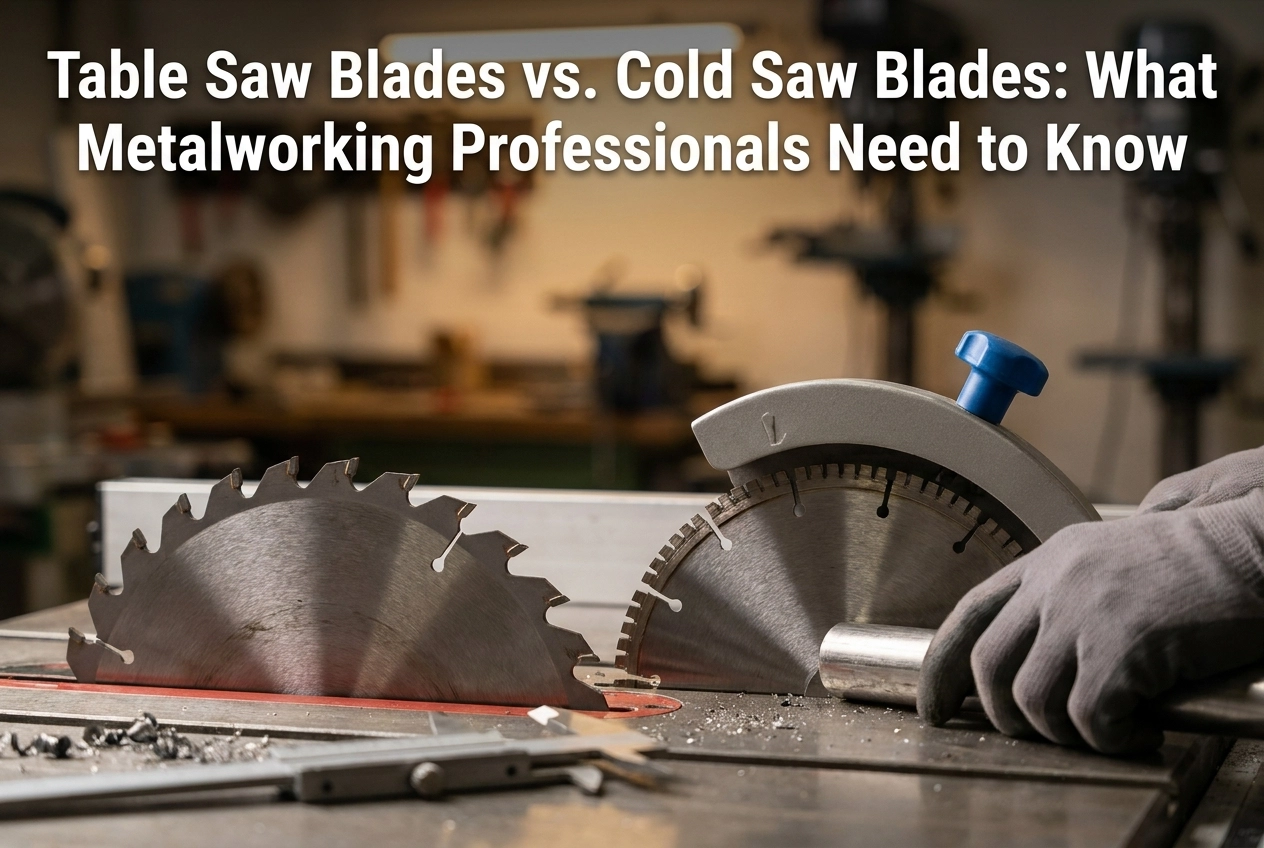
Choosing the wrong blade for a metalworking job does not just slow you down; it can compromise your cuts, damage your workpiece, and create serious safety hazards. For professionals working with metal, understanding the difference between your cutting tools is not optional; it is essential.
Table saw blades are a familiar staple in most shops, but many metalworking professionals find themselves debating whether these versatile cutters can hold their own against cold saw blades for demanding metal applications. The answer is more nuanced than a simple yes or no, and that nuance is exactly what separates good work from great work.
In this post, we will break down the key differences between table saw blades and cold saw blades, examining how each performs when cutting metal, where each tool excels, and which option makes the most sense for specific applications. Whether you are outfitting a new shop or reconsidering your current setup, this comparison will give you the technical clarity you need to make a confident, informed decision. Let’s get into it.
What Is a Table Saw Blade?
Table saw blades are carbide-tipped circular cutting tools engineered specifically for wood, composite materials, and plastics. They operate at high rotational speeds, typically ranging from 3,000 to 5,000+ RPM depending on the machine, and the entire design philosophy centers on shearing fibrous organic material cleanly and efficiently. Tungsten carbide teeth, roughly twice as stiff and dense as steel, maintain a sharp cutting edge through extended woodworking sessions. That extreme hardness, however, comes with a significant trade-off: carbide is inherently brittle and requires diamond tooling or professional resharpening equipment to recondition when edges dull.
Tooth Geometry and Design Intent
Three primary tooth configurations define the table saw blade category. ATB (Alternate Top Bevel) grinds feature high tooth counts optimized for clean crosscuts with minimal tear-out, making them the preferred choice for plywood and finish carpentry. FTG (Flat Top Grind) blades use fewer teeth with a more aggressive profile suited to fast rip cuts along the grain. Combination blades attempt to balance both tasks adequately for general shop use. Across all three configurations, the common thread is the same: large gullets for rapid chip evacuation, aggressive hook angles, and relatively low tooth-per-inch counts. These characteristics are precisely what makes table saw blades effective on wood and precisely what makes them unsuitable for metalworking environments.
Where Table Saw Blades Break Down
High RPM operation generates substantial heat at the cut zone. In wood cutting, this heat dissipates quickly because fibrous chips carry thermal energy away from the blade, and wood does not work-harden under pressure. Metal is an entirely different problem. Ferrous materials conduct and retain heat aggressively, and the geometry of a standard carbide-tipped blade, designed to shear rather than chip, causes that heat to concentrate at the tooth tips. The result is rapid dulling, micro-fracturing of carbide teeth, potential blade warping, and in production environments, a serious risk of tooth ejection. As detailed in this comparison of wood-cutting vs. metal-cutting saw blades, the fundamental engineering profiles of these two blade categories are incompatible, not interchangeable.
Even aluminum, which carbide can technically cut under controlled hobbyist conditions, presents problems at production volume. Aluminum alloys load the gullets differently than wood, generate gummy chip buildup, and without dedicated blade geometry and proper lubrication, accelerate wear at rates that make carbide-tipped table saw blades economically unviable for any sustained metalworking application. For a detailed breakdown of the differences between wood and metal cutting blades, the contrast in tooth geometry, hook angles, and operational speed requirements makes the engineering boundary clear.
Understanding these design limitations is not simply academic. For manufacturers, fabricators, and metalworking professionals who require precise, repeatable cuts in steel tubing, structural profiles, or aluminum extrusions, the table saw blade is the wrong tool category entirely. Dedicated metalworking solutions, engineered from the ground up for lower speeds, controlled heat management, and metal-specific tooth geometry, are the only viable path to consistent precision and acceptable blade service life in industrial production settings.
What Is a Cold Saw Blade?
Where table saw blades are purpose-built for wood and composites at high rotational speeds, cold saw blades occupy an entirely different engineering category. These are circular metal-cutting blades designed to operate at remarkably low RPM, typically between 15 and 120 RPM depending on blade diameter and the material being cut. That low-speed operation is not a limitation; it is the entire point. The controlled cutting action allows the blade’s teeth to shear through metal with precision rather than grinding or abrading through it.
The “cold” in cold saw refers directly to the thermodynamic behavior at the cut zone. As the blade teeth engage the workpiece, generated heat transfers into the metal chips and evacuates with them, keeping both the blade and the workpiece at near-ambient temperature throughout the cut. This chip-transfer heat management is the defining characteristic that separates cold sawing from abrasive cutoff wheels, friction saws, and other metal-cutting methods that generate significant heat at the cutting surface. The practical result is the complete elimination of a heat-affected zone (HAZ), which means the metal’s metallurgical properties and dimensional accuracy remain fully intact. For applications requiring subsequent welding, threading, or precision assembly, this matters enormously.
The cut quality advantages of cold sawing are measurable and consistent: burr-free edges, tight dimensional tolerances, and surfaces ready for immediate downstream processing without additional deburring or grinding. These characteristics make cold saw blades the preferred cutting solution in tube and pipe manufacturing, structural steel fabrication, and automotive component production where repeatability across high production volumes is non-negotiable.
Cold saw blades are available in HSS (High Speed Steel) grades, including M2 and M35 cobalt variants, as well as TiAlN and TiCN coated options that extend service life under demanding conditions. Unlike the carbide-tipped table saw blades discussed in the previous section, cold saw blades are fully resharpenable and reconditionable, making them a capital investment rather than a consumable. A single blade can deliver multiple service cycles with proper maintenance, fundamentally changing the cost-per-cut calculation for industrial operations.
Applications span aerospace, automotive, HVAC, structural steel, and general precision metalworking. Anywhere cut quality and dimensional repeatability are critical production requirements, cold saw blades are the appropriate tool for the job.
Head-to-Head Comparison: Table Saw Blades vs. Cold Saw Blades
The performance gap between these two blade categories becomes immediately clear when you examine the numbers side by side. Table saw blades spin at 3,000 to 5,000+ RPM, a speed range optimized for shearing through wood fibers cleanly and efficiently. Cold saw blades, by contrast, operate between 15 and 120 RPM, a dramatically slower rotational speed that completely redefines how the cutting action works. This difference in RPM is not simply a matter of scale; it fundamentally changes the physics of every cut, influencing heat generation, chip formation, surface finish, and the long-term condition of the workpiece.
Blade Construction and Material Engineering
The materials used in each blade type reflect their vastly different operating environments. Table saw blades use carbide tips brazed onto a hardened steel body, a construction well-suited to high-speed wood cutting where the carbide geometry slices cleanly through grain. Cold saw blades take a different approach entirely. They are manufactured from solid HSS tool steel, most commonly M2 or M35 grades, or they incorporate advanced surface coatings such as TiAlN or TiCN. These coatings significantly extend cutting life, particularly when working with harder metals or high-cycle production schedules. The solid HSS construction gives cold saw blades a structural integrity that carbide-tipped woodworking blades simply are not designed to match in metal-cutting applications.
Heat, Cut Quality, and Finishing Requirements
At high RPM, table saw operation generates substantial friction-based heat at the cut zone. In metalworking contexts, this heat is destructive; it can alter workpiece hardness, compromise dimensional tolerances, and introduce thermal stress into cut edges. Cold saws eliminate this problem by transferring heat into the chip rather than the workpiece. The low rotational speed produces thick, discrete chips that carry heat away from the cut zone, keeping the metal cool throughout the operation. The practical result is a mill-quality, burr-free cut surface that requires no secondary deburring, grinding, or finishing in most production applications. Practitioners in fabrication environments consistently note that cold saw cuts go directly to assembly without additional processing. Table saw cuts on metal, by comparison, typically produce burrs, may introduce work-hardening at the cut edge, and require follow-up operations before the part is usable.
Longevity, Resharpening, and Total Cost of Ownership
One of the most important economic distinctions between these blade types is resharpening viability. Carbide-tipped table saw blades are largely treated as consumables; resharpening services exist but often approach the cost of blade replacement, making the economics marginal at best. HSS cold saw blades operate under a fundamentally different cost model. A quality HSS blade can be resharpened multiple times across its service life, with each resharpening restoring cutting geometry and edge performance at a fraction of new-blade cost. For production metalworking operations running high cut volumes, this resharpening advantage translates into a measurable reduction in total cost of ownership over time.
Application Fit: Matching the Tool to the Environment
Table saw blades are precision tools within their intended domain. For woodworking shops, furniture makers, and carpentry professionals, they deliver exactly the performance the application demands. Cold saw blades occupy a completely separate application space. They are purpose-built for production metalworking, fabrication shops, tube and pipe manufacturing, and precision manufacturing environments where cut quality, dimensional accuracy, and repeatable performance across high cycle counts are non-negotiable requirements. Attempting to use a table saw blade for structural metal cutting is not simply a performance compromise; it is an application mismatch at the engineering level. For metalworking professionals evaluating cutting solutions, the cold saw blade is the purpose-designed tool for the job.
Cold Saw Blade Materials and Coatings Explained
Selecting the right cold saw blade starts with understanding what the blade is actually made of and how its surface is treated. Material grade and coating determine hardness, heat resistance, wear life, and compatibility with your specific workpiece. Cold Saw Blade Store carries the full spectrum of these options, and knowing the differences puts you in a position to make a precise, cost-effective decision for your application.
HSS M2 Tool Steel
M2 tool steel is the industry-standard grade for general-purpose cold saw blades. After heat treatment, M2 reaches a hardness of approximately 63 to 65 HRC, delivering the combination of edge retention and toughness that most production environments require. It performs reliably across carbon steel, alloy steel, structural steel, and standard stainless steel applications, making it the default starting point for shops that cut a broad mix of materials without extreme demands on feed rate or hardness. For the majority of fabrication and manufacturing operations, M2 provides the right balance of performance and value.
HSS M35 Cobalt Tool Steel
When M2 reaches its limits, M35 cobalt HSS is the appropriate upgrade. The addition of approximately 5% cobalt raises hot hardness significantly, meaning the blade retains its cutting edge at elevated temperatures that would cause standard M2 to soften and wear prematurely. This makes M35 the correct choice for hardened steels, high-nickel alloys, and stainless steel cut at higher feed rates. Production environments running tighter cycle times or processing difficult materials will see measurably longer blade life and fewer interrupted cuts by moving to M35 rather than pushing M2 beyond its design limits.
TiAlN-Coated Blades
Titanium aluminum nitride (TiAlN) coating adds a hard, oxidation-resistant surface layer to the underlying HSS substrate. This coating is engineered for dry cutting environments where heat at the cutting edge is a primary concern. TiAlN-coated blades excel on ferrous metals and titanium alloys, enabling higher cutting speeds and substantially extended blade life compared to uncoated equivalents. The coating’s thermal stability allows the blade to dissipate heat more effectively, which is critical when coolant is not part of the cutting setup.
TiCN-Coated Blades
Titanium carbonitride (TiCN) coating takes a different approach. Its lower coefficient of friction compared to TiAlN reduces the tendency for workpiece material to adhere to the blade surface, a problem known as built-up edge. This makes TiCN-coated blades preferable for non-ferrous metals, stainless steel grades prone to work hardening, and any application where material smearing or adhesion compromises cut quality and finish. Choosing TiCN over TiAlN in these scenarios directly improves surface finish and reduces the frequency of blade cleaning and reconditioning.
Aluminum-Specific Cold Saw Blades
Aluminum and other non-ferrous alloys require a purpose-built blade geometry rather than a simple coating change. These blades feature higher rake angles and optimized gullet depth, design choices that prevent chip loading and allow the softer, more ductile material to clear the cut zone cleanly. Without this geometry, aluminum smears and galls against the blade, producing rough edges and rapid blade degradation. The same geometry applies to brass, copper, and similar alloys. For detailed guidance on matching blade specifications to your specific material and machine, Cold Saw Blade Store’s blade recommendation tool and resources like the mechanics behind cold saw operation can help clarify the engineering rationale behind each option.
Selecting the Right Blade Diameter and Tooth Configuration
Cold saw blades are available across a wide diameter range, from 2.5 inches up to 48 inches, and selecting the correct diameter is not simply a matter of fitting the blade to the machine. Three variables drive this decision: the machine’s arbor size, the cross-section of the material being cut, and the required depth of cut. A blade that is undersized for the material cross-section will not complete the cut cleanly, while an oversized blade on a machine with insufficient arbor support introduces vibration and runout that degrades both cut quality and blade life. Before specifying a diameter, verify your machine’s rated capacity and confirm the arbor bore matches the blade bore precisely. Even a fractional mismatch in arbor fit compromises concentricity and accelerates wear at the tooth tips.
Tooth Count: Coarse vs. Fine Pitch
Tooth count is arguably the most consequential variable in cold saw blade specification, because it directly controls the balance between material removal rate and surface finish quality. Fewer teeth, a coarser pitch, create larger gullets that evacuate chips more effectively and allow higher feed rates. This configuration is the correct choice for structural steel sections, heavy-wall tubing, and bar stock where throughput matters more than surface smoothness. Finer pitch blades, carrying more teeth across the same diameter, reduce chip load per tooth and produce noticeably smoother finishes. These are the appropriate specification for thin-wall tubing, sheet goods, and precision components where surface quality is a production requirement rather than a secondary concern. Mismatching pitch to material is one of the most common causes of premature blade failure in production environments; a fine-pitch blade applied to heavy structural cuts will pack chips in the gullets, generate excessive heat, and wear out well before its rated service life. You can consult the Cold Saw Blade Guide for tooth-count recommendations matched to material cross-sections.
Speed Calibration and Surface Footage
RPM alone is not a useful specification metric for cold saw blades, because a larger-diameter blade moving at the same RPM generates substantially higher surface speed at the cutting edge. The correct unit of measure is surface feet per minute (SFPM). For HSS blades cutting carbon steel, the target range is 80 to 120 SFPM at the cut zone. Stainless steel and high-alloy steels require lower surface speeds to prevent heat buildup that destroys blade temper. Running above the recommended SFPM causes thermal damage; running below it produces rubbing rather than cutting, which accelerates wear without removing material efficiently.
Tooth Geometry Matching
Rake angle, clearance angle, and gullet size must be selected based on material hardness and the type of cut being made. Positive rake angles reduce cutting resistance and work well for softer, non-ferrous materials such as aluminum. For harder ferrous steels, neutral or negative rake angles are preferred because they deliver more controlled, lower-shock cutting action that protects the tooth edge under load. Gullet size must be proportioned to the expected chip volume; undersized gullets on aggressive cuts will pack and cause blade deflection.
Selecting the wrong combination of diameter, tooth count, or geometry does not merely reduce efficiency; it accelerates wear, produces out-of-tolerance cuts, and can result in complete blade failure mid-production run. In high-volume manufacturing environments, the cost of a mis-specified blade includes not only the blade itself but also downtime, scrap material, and rework. Proper specification at the outset is the most cost-effective decision a production team can make.
Resharpening vs. Replacement: Total Cost of Ownership for Cold Saw Blades
The economics of cold saw blade ownership shift dramatically once you factor in resharpening. Unlike carbide-tipped blades that are discarded when ddulled, HSS cold saw blades are engineered for multiple sharpening cycles, with each cycle restoring full cutting performance at a cost that typically runs 20 to 40 percent of new blade price. That gap compounds quickly across a production environment. According to the ROI analysis published by ColdSawBladeStore.com, shops operating on a replace-only program spend 10 to 12 times more on cold saw blades than shops running a sharpen-first program for equivalent cutting volume. That is not a marginal efficiency gain; it is a fundamental restructuring of tooling costs.
How Many Cycles Can You Expect?
A single HSS cold saw blade can yield 5 to 10 or more resharpening cycles depending on several interdependent variables: blade diameter, the hardness of the material being cut, feed rate discipline, and how consistently the blade is pulled for service before significant edge degradation occurs. Blades cutting softer structural steel on a regular maintenance schedule consistently reach the upper end of that range. Blades cutting hardened alloys or running past their service indicators before sharpening compress the cycle count. The practical implication is that cost-per-cut, not purchase price, is the correct metric for evaluating blade investment.
What Professional Reconditioning Actually Restores
Professional resharpening goes well beyond re-profiling tooth geometry. A proper reconditioning service addresses blade body flatness, bore concentricity, and overall surface condition, returning the blade to near-new operational specification. This matters because a blade that cuts with vibration due to a flatness deviation or concentricity issue will wear faster and produce inferior cuts regardless of how sharp the teeth are. Restoring the full geometry ensures that each resharpening cycle delivers the same cut quality as a new blade, protecting both part finish and machine components.
Sustainability as a Procurement Factor
Resharpening also aligns with sustainability objectives that are increasingly embedded in manufacturing procurement policies. Extending blade service life reduces the volume of high-grade tool steel entering the waste stream, a measurable contribution toward waste-reduction and circular economy mandates that procurement teams at larger manufacturers are now required to document and report.
ColdSawBladeStore.com offers professional blade resharpening and reconditioning services designed to help manufacturers maximize return on every blade purchased, maintaining consistent cut quality across full production cycles.
Why Demand for Precision Metal Cutting Blades Is Accelerating
The numbers tell a compelling story. The HSS cold saw blade market is projected to grow at an 11.8% CAGR from 2026 to 2033, according to market dynamics analysis of the HSS cold saw blade segment. That growth rate is more than double the broader saw blades market, which is forecast at 3.49% to 4.7% CAGR over similar periods. This divergence is not coincidental. It reflects a structural shift in industrial manufacturing toward tighter tolerances, higher production volumes, and stricter quality standards that general-purpose cutting tools simply cannot meet. Precision metalworking is becoming a growth category in its own right, and cold saw blades are at the center of that expansion.
Circular blade geometry is a significant factor in this momentum. Circular blades currently hold a 41.7% type-segment share of the global saw blades market in 2026, confirming that this format remains the dominant configuration across cutting applications. Cold saw blades operate within this same format, benefiting from decades of engineering refinement in circular blade design while adding the metallurgical precision required for ferrous and non-ferrous metal cutting.
Automation is reshaping demand in concrete ways. The proliferation of CNC-integrated cold saws and fully automated cutting cells means blades are now running in high-cycle environments with minimal operator intervention. In these conditions, dimensional drift is not acceptable; a blade that loses its tolerance profile mid-run creates scrap, rework, and downtime. Buyers are specifying blades with tighter manufacturing tolerances and higher-durability materials, including cobalt-enriched M35 HSS grades and performance coatings such as TiAlN and TiCN, specifically to sustain cut quality across thousands of cycles without resharpening intervals disrupting production.
Compliance requirements are also reshaping procurement. ISO and ANSI conformance has moved from a preferred criterion to a mandatory one in aerospace, automotive, and defense supply chains, where traceability documentation and specification conformance are required at every tier. High-speed steel metal cutting tools market analysis confirms that non-compliance creates direct market access barriers for blade suppliers operating in these sectors.
North America holds a USD 4 billion position in the HSS metal cutting tools market, supported by sustained manufacturing activity and ongoing supply-chain diversification. For US-based metalworking suppliers with deep technical expertise and domestic inventory, this regional strength represents a durable competitive advantage as industrial buyers prioritize reliability and specification support alongside price.
How ColdSawBladeStore.com Supports Metalworking Professionals
ColdSawBladeStore.com, operated by Grand Blanc Industries, is built specifically around the needs of metalworking professionals who require precision cold saw blades rather than general-purpose cutting tools. The catalog covers new cold saw blades in M2 HSS, TiAlN/TiCN coated, and aluminum-cutting variants, spanning a size range that accommodates the full spectrum of industrial cold saw applications. Blades are organized by size, type, and compatible machine brand, which allows procurement managers to cross-reference existing machine specifications against available inventory and eliminate costly ordering errors before they reach the production floor.
Technical Expertise Directly Accessible to Engineers and Buyers
With over 80 years of combined staff experience, the team at ColdSawBladeStore.com provides hands-on technical support covering tooth configurations, cutting speeds, RPM settings, and material-specific blade selection. This level of guidance matters because, as the site’s own tooth-count resources note, an estimated 90% of metalworking errors trace back to using the wrong cutting tool. The Cold Saw Blade Guide includes speed charts and an SFPM-to-RPM calculator that engineers can use to dial in precise machine settings for specific materials. Customers can contact the technical support team directly to specify blades by material type, machine model, diameter, and application, ensuring the right blade reaches the production floor without guesswork or trial-and-error downtime.
Competitive Pricing and Resharpening Services
For procurement professionals managing tight tooling budgets in high-volume production environments, ColdSawBladeStore.com offers a best-price guarantee with competitor price matching across all new blades and sharpening services. Most new blade orders ship same day, and free ground shipping applies to orders of three or more blades within the contiguous United States. Beyond new blade procurement, professional resharpening and reconditioning services allow manufacturers to extend blade service life significantly rather than replacing prematurely. Customers submit a quote request specifying blade diameter, quantity, and machine description, with same-day turnaround available. Reconditioning HSS blades through multiple sharpening cycles reduces per-cut tooling costs substantially and aligns with sustainability objectives by keeping usable blades in service longer and reducing material waste across manufacturing operations.
Frequently Asked Questions
Can I use a cold saw blade on a table saw?
No, and this is a critical safety point. Cold saw blades are engineered for machines operating between 15 and 120 RPM. A standard table saw runs at 3,000 to 4,500 RPM, which is orders of magnitude beyond the safe operating envelope of any cold saw blade. Mounting a cold saw blade on a table saw would instantly exceed its rated speed, creating a catastrophic fragmentation hazard and destroying the blade entirely. These are fundamentally incompatible machine types with entirely different mechanical specifications. Never attempt to interchange blades between them.
Can a table saw blade cut metal?
Carbide-tipped table saw blades can make incidental cuts in thin, non-ferrous metals such as aluminum sheet, but this does not make them suitable for metalworking applications. Without flood coolant or controlled low-RPM cutting, heat builds rapidly at the tooth edge, accelerating dulling and degrading cut quality within a very short period. For any production metalworking environment, thin non-ferrous cutting is the absolute ceiling of what a table saw blade can manage, and even then, the results are inconsistent. Sustained ferrous metal cutting on a table saw blade is not viable under any practical conditions.
What is the difference between HSS M2 and M35 cold saw blades?
M2 is the standard high-speed steel grade used for general-purpose metal cutting across a broad range of materials. M35 incorporates approximately 5% cobalt, which elevates hot hardness and wear resistance significantly. In practical terms, M35 is the preferred choice when cutting stainless steel, high-tensile alloys, or any material that places elevated thermal and mechanical stress on the blade. Both grades are hardened and triple-tempered to approximately 64 to 65 HRc. For standard structural steel and tubing applications, M2 performs reliably. For demanding production work involving harder alloys, M35 delivers a measurable advantage in blade life.
How do I know when a cold saw blade needs resharpening?
Four indicators point clearly to a blade that needs attention. First, increased burring at the cut edge signals that teeth are no longer cutting cleanly. Second, higher cutting force or audible machine strain suggests teeth are dragging rather than shearing. Third, visible heat discoloration at the cut zone indicates friction is rising beyond acceptable limits. Fourth, reduced dimensional consistency in cut parts means the blade is no longer holding the precision your application demands. Catching these signs early and scheduling resharpening promptly extends overall blade service life and avoids more costly damage.
What blade diameter do I need for my cold saw?
Blade diameter is governed by two variables: your machine’s arbor size and the maximum cross-section of material you need to cut. A blade that fits the arbor but lacks sufficient diameter for the material cross-section will not complete the cut. ColdSawBladeStore.com carries blades from 2.5 to 48 inches in diameter and provides technical support to help you confirm the correct specification for your machine and material combination.
Are TiAlN-coated cold saw blades worth the additional cost?
For high-volume production cutting ferrous metals or harder alloys, yes. TiAlN coatings reach a surface hardness of approximately 3,200 HV and form an aluminum oxide layer under high temperatures, providing exceptional thermal stability. This allows higher cutting speeds and feeds while reducing friction at the tooth surface. The upfront cost is higher than an uncoated blade, but extended blade life across demanding production cycles lowers cost per cut meaningfully over the blade’s full service life. For occasional or light-duty applications, an uncoated M2 blade may serve adequately, but in sustained production environments, the coating investment typically pays for itself.
Choosing the Right Blade Starts with Knowing the Difference
The distinction between table saw blades and cold saw blades is not a matter of preference or minor specification detail. It is an operational boundary with measurable consequences. Mounting the wrong blade category on a metal-cutting machine increases tooling spend, degrades cut quality, and introduces production delays that compound quickly across a high-volume shop floor. Getting this right from the start is the more cost-effective path by every measure.
For metalworking professionals, the correct specification begins with cold saw blades in HSS M2, M35 cobalt, TiAlN/TiCN coated, or aluminum-specific variants, each matched to machine RPM, material type, blade diameter, and tooth configuration as interdependent variables. No single factor stands alone. A correctly specified blade, properly maintained through a structured resharpening program, outperforms a new blade selected without that discipline.
Resharpening is a practical production strategy, not simply a cost-reduction tactic. It extends blade service life, reduces long-term tooling spend, and supports sustainability goals by keeping usable tooling out of waste streams. For any operation with recurring blade needs, a resharpening program delivers measurable return on investment over time.
ColdSawBladeStore.com, operated by Grand Blanc Industries, provides the full product range, over 80 years of combined staff experience, and dedicated resharpening services to support metalworking operations at any production scale. Contact the technical team for blade specification guidance or browse the complete cold saw blade inventory to find the right blade for your application.
Conclusion
Choosing the right blade is not just a technical decision; it is a professional one. Table saw blades can handle light metal cutting tasks with the right setup, but cold saw blades deliver superior precision, cleaner cuts, and longer tool life for dedicated metalworking applications. Heat management, material compatibility, and cut quality are the three factors that will consistently separate these two tools in real shop conditions.
Now that you understand the core differences, take action. Audit your current blade setup, evaluate the metals you cut most frequently, and invest in the tooling that matches your actual workload. The right blade will save you time, reduce waste, and protect your equipment. Do not let the wrong tool hold your work to a lower standard than you are capable of. Upgrade your knowledge, then upgrade your shop.
