
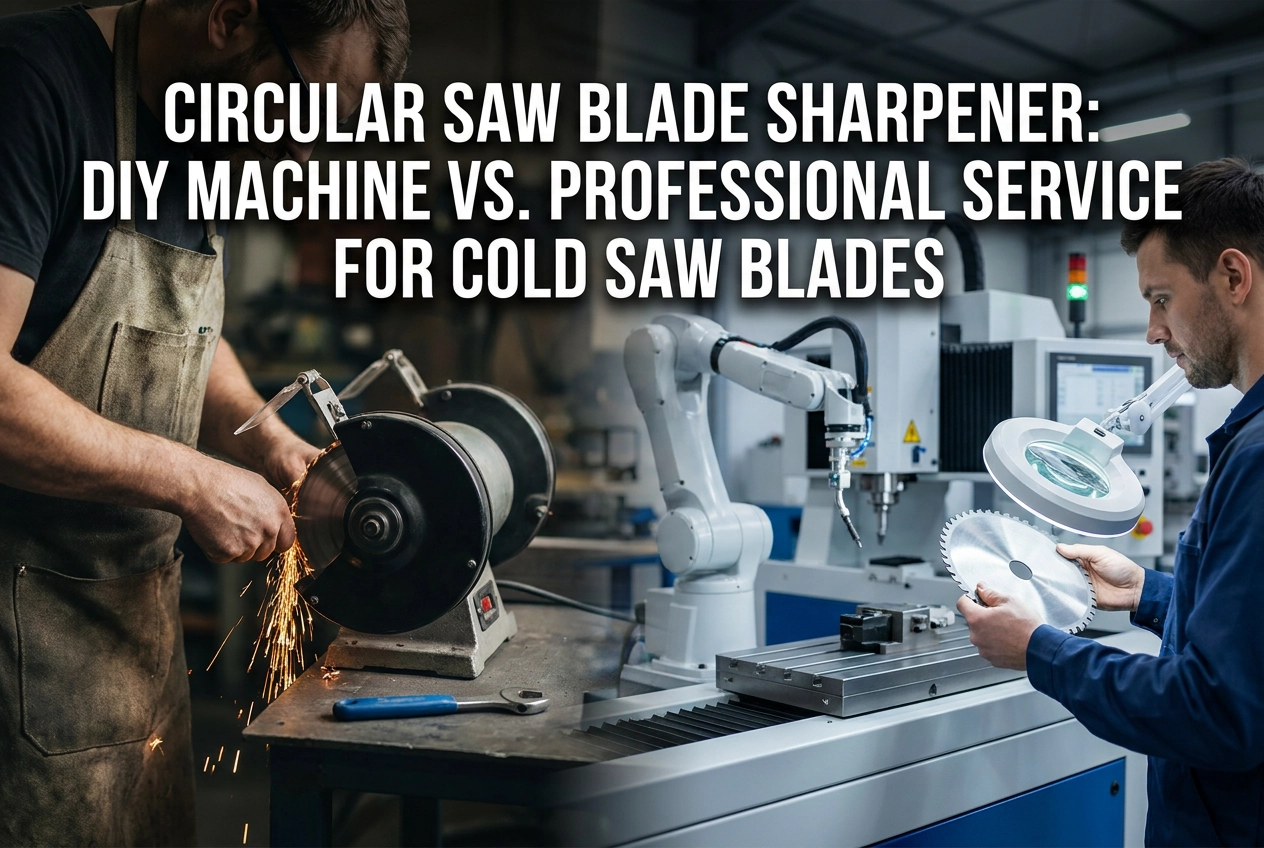
A dull cold saw blade does not just slow you down; it costs you money, ruins your cuts, and puts unnecessary stress on your machine. If you have been dealing with ragged edges or excessive heat during cuts, the condition of your blade is almost certainly the culprit. The question most serious metalworkers eventually face is straightforward: should you invest in a circular saw blade sharpener for in-house use, or send your blades out to a professional sharpening service?
Both options have real merit, and choosing the wrong one for your situation can mean wasted time, wasted money, or both. In this comparison, we will break down exactly what separates DIY blade sharpening machines from professional services when it comes to cold saw blades specifically. You will learn about upfront costs, long-term value, sharpening precision, and the practical realities of each approach. By the end, you will have a clear picture of which solution aligns with your workflow, your budget, and the performance standards your work demands.
Why Blade Sharpening Matters More in Metal Cutting
Cold saw blades represent a capital investment that operates in an entirely different financial tier than woodworking blades. While a standard carbide-tipped woodworking blade runs $30 to $60, cold saw blades for metal fabrication range from $200 to $800 or more per blade, depending on diameter, tooth count, and coating. Shops operating on a replace-only program can spend 10 to 12 times more on blades than operations that prioritize sharpening first, for equivalent cutting volume. That multiplier makes the ROI calculation for professional sharpening not a matter of preference, but straightforward math.
The consequences of running a dull cold saw blade extend well beyond slower cutting. A degraded cutting edge generates excess heat at the cut zone, which accelerates tooth wear, increases burring on finished part surfaces, and places measurable strain on the saw motor. Each of these outcomes compounds into downstream production costs: burring triggers part rejection, heat shortens blade life further, and motor strain increases maintenance intervals. The blade itself is only one line item in that failure chain.
Professional sharpening addresses this at the root. At roughly 25 cents per tooth, certified technicians using CBN grinding wheels restore hook angles, tooth geometry, and edge tolerances to original manufacturer specifications. A 60-tooth cold saw blade resharpened multiple times over its service life represents a fraction of the cost of repeated blade replacement.
Operational downtime compounds the financial case further. Unplanned blade changeovers interrupt production schedules, and rejected parts from poor cut quality carry costs that rarely appear in a blade budget but consistently appear on the shop floor. Scheduling sharpening proactively eliminates that variability.
Sustainability is increasingly factored into procurement decisions at manufacturing facilities. HSS cold saw blades are high-grade alloy steel tools; resharpening them extends service life and reduces resource consumption tied to new blade production, keeping precision-engineered steel out of the waste stream longer.
Cold Saw Blades Are a Specialized Sharpening Category
Cold saw blades do not belong in the same sharpening category as woodworking or construction circular saw blades, and treating them as interchangeable is one of the costliest mistakes a metalworking operation can make. HSS cold saw blades operate at dramatically lower RPMs than woodcutting blades, typically in the range of 15 to 100 RPM depending on material and blade diameter, compared to the thousands of RPMs common in woodworking applications. This fundamental difference in operating speed is paired with finer tooth geometry engineered for chip-load precision in metal, not the aggressive bite of a wood blade. The equipment and technique required to restore a cold saw blade are not a scaled-down version of woodworking blade service; they are categorically different.
Tooth angles, hook angles, and edge tolerances on HSS cold saw blades are held to tighter specifications because metalworking applications demand burr-free, dimensionally accurate results. A woodworking cut that is slightly rough or fractionally out of tolerance is often acceptable. A metal cut that is out of specification can ruin a finished part, create downstream assembly problems, or generate safety hazards in structural or precision components. Specialized providers use CNC grinding equipment that holds tolerances of less than .001″ total indicator roundness, a standard that general-purpose sharpening shops simply cannot meet with equipment configured for carbide woodworking blades. According to industrial sharpening equipment specifications from Saw and Specialty Corporation, dedicated cold saw grinding requires entirely separate machinery from the equipment used for carbide-tipped woodworking blades.
TiAlN and TiCN coated blades introduce an additional layer of complexity that general sharpening services are rarely equipped to handle. These physical vapor deposition coatings alter the hardness and surface characteristics of the blade, which directly affects how grinding wheels interact with the tooth faces and rake surfaces during sharpening. Sharpening protocols must account for whether the coating is being preserved in areas not directly ground, partially removed at the cutting edge, or whether the blade will require recoating after the grinding process. Mishandling coated blades on inappropriate equipment risks stripping the coating inconsistently, compromising both the surface finish and the thermal resistance properties the coating was designed to provide.
General-purpose blade sharpening services, those primarily equipped for carbide woodworking or construction blades, typically lack the specialized CNC grinding machines and CBN wheel configurations required to hold cold saw tolerances. CBN (cubic boron nitride) grinding wheels are the correct abrasive for HSS cold saw work; diamond wheels, which are standard for carbide woodworking blades, are not appropriate substitutes. The cold saw blade sharpening service offered by Cold Saw Blade Store reflects this distinction directly, providing HSS-specific sharpening protocols rather than adapting a general circular saw service.
Misidentifying a cold saw blade and submitting it to a general sharpening service is not a neutral error. Sharpening on inappropriate equipment can alter hook angles, change tooth geometry, and introduce edge inconsistencies that cause the blade to cut dull almost immediately after returning to service. Rather than extending blade life, incorrect sharpening accelerates wear and can eliminate several future resharpening cycles from what should be a blade capable of being reconditioned up to twenty times over its service life.
How DIY Circular Saw Blade Sharpening Machines Work
Entry-level and mid-range circular saw blade sharpening machines operate on a straightforward mechanical principle. A motorized grinding wheel, typically aluminum oxide or a basic diamond abrasive wheel, is mounted on an adjustable carriage that indexes around the blade one tooth at a time. A spring-loaded pawl or indexing pin advances the blade sequentially, positioning each tooth against the wheel for a grinding pass. The setup sounds simple, but the execution is where problems emerge.
Operator Skill Is the Limiting Variable
Hook angle and bevel angle are set manually using mechanical stops and adjustable guides. The accuracy of every tooth on the blade is therefore a direct function of how consistently the operator executes the setup and maintains it across dozens of grinding passes. Hands-on testing of consumer sharpeners has documented that even careful setup can result in measurable play in the indexing mechanism, forcing the operator to apply manual pressure to achieve consistent grinding contact. In the same testing, close inspection after sharpening revealed ragged cutting edges and chipped carbide corners on individual teeth, damage that was not present before the session began. For lower-cost woodworking blades, this level of outcome variability may be acceptable. For precision metalworking applications, it is not.
Why HSS Cold Saw Blades Fall Outside the Design Envelope
Consumer and light-industrial sharpeners are built around the geometry of carbide-tipped woodworking blades, which feature larger tooth pitch and wider tolerances. Adapting these machines to the finer tooth geometry and tighter dimensional requirements of HSS cold saw blades is generally impractical and often outside the machine’s specified operating range. The broader guide to circular saw blade sharpening confirms that while sharpening applies across wood, metal, and composite applications, the equipment designed for woodworking geometry is not interchangeable with tooling engineered for metal-cutting blades.
The Heat Problem: An Invisible Failure Mode
Perhaps the most consequential limitation of DIY sharpeners is the absence of filtered, high-pressure coolant systems. Dry grinding generates localized heat at the tooth tip. For HSS cold saw blades, which depend on precisely maintained metallurgical hardness to cut metal cleanly at operating speeds, this heat can alter the material’s properties in ways that are completely invisible to the naked eye. The blade will look sharp. It will pass a visual inspection. It will only reveal the damage once it underperforms in an actual cut, producing poor finish quality, accelerated wear, or unexpected tooth failure mid-job.
DIY sharpening serves a legitimate purpose in high-volume woodworking and construction environments, where blades are lower in cost, tolerances are wider, and some variation across the tooth profile is operationally acceptable. It is not, however, an appropriate method for reconditioning precision cold saw blades where metallurgical integrity and tight geometric tolerances are non-negotiable production requirements.
How Professional Cold Saw Blade Sharpening Works
Professional HSS cold saw blade sharpening begins before any grinding wheel makes contact with the blade. Every blade entering a professional facility is first submerged in an ultrasonic cleaning bath using solutions specifically formulated for saw blades. This step removes cutting fluid residue, metal fines, and compacted debris that accumulate during production use. Contaminants left on the blade surface would interfere with grinding wheel contact and compromise measurement accuracy, making pre-cleaning a functional prerequisite rather than a cosmetic step.
Once cleaned, blades are processed on CNC Loroch grinding machines, the industry-standard equipment engineered specifically for HSS cold saw blade sharpening. Every tooth surface is ground under high-pressure, filtered, and chilled oil, with CBN (cubic boron nitride) grinding wheels maintaining consistent wheel geometry throughout the process. The chilled oil coolant system is not optional; heat generated during grinding without adequate cooling can alter the metallurgical properties of HSS steel, softening the material and accelerating edge wear after the blade returns to service.
CBN wheels are the correct abrasive choice for HSS cold saw blades for three interconnected reasons. CBN is harder than the HSS material being ground, it wears at a controlled and predictable rate, and it generates significantly less heat than conventional abrasive wheels. Together, these properties deliver dimensional consistency across every tooth on the blade, a standard that aluminum oxide wheels cannot reliably meet.
The CNC-controlled nature of Loroch grinding eliminates the operator variability that defines manual sharpening setups. Hook angles, rake faces, clearance angles, and gullet depths are programmed to specification and reproduced identically across every tooth. No manual process can replicate this level of geometric precision at scale.
Professional facilities also offer services that fall completely outside what any DIY circular saw blade sharpener can perform: re-toothing for chipped or cracked teeth, complete gumming to restore gullet depth, and custom tooth count modifications. These capabilities require the full mechanical range of CNC grinding platforms.
The team at Grand Blanc Industries brings over 80 years of combined staff experience to cold saw blade sharpening at ColdSawBladeStore.com. That depth of knowledge supports more than grinding accuracy; it enables technicians to correctly identify blade specifications, recognize blades that have exceeded their resharpening service life, and provide guidance on optimal sharpening intervals based on your specific cutting application and material type.
DIY Sharpening Machine vs. Professional Service: Side-by-Side
The differences between DIY sharpening machines and professional cold saw blade sharpening services become stark when evaluated side by side across the criteria that matter most to metalworking operations.
Precision and Consistency
Professional CNC grinding equipment restores tooth geometry, hook angles, and edge tolerances to original manufacturer specifications with programmed repeatability across every tooth on the blade. Each tooth receives identical treatment because the machine executes the same calibrated grinding path without operator variability. DIY sharpening machines depend on manual setup accuracy and the operator’s ability to replicate consistent positioning tooth by tooth. Even experienced operators acknowledge that small setup deviations compound across a 60-tooth or 80-tooth cold saw blade, producing measurable inconsistencies that affect cut quality and blade balance.
Equipment Cost vs. Service Cost
Entry-level DIY blade sharpeners start around $200, but machines capable of handling industrial blade geometry and tooth counts climb into several thousand dollars. That capital outlay does not include ongoing consumable grinding wheel replacements. Professional sharpening services eliminate capital equipment costs entirely, charging on a per-tooth basis with no machine ownership, maintenance, or consumable overhead. For shops that sharpen blades periodically rather than daily, the per-tooth service model is straightforwardly more economical.
Blade Type Compatibility
Most consumer and mid-tier DIY sharpening machines are engineered around carbide woodworking blades, which have fundamentally different tooth geometry and metallurgical requirements than HSS cold saw blades. Professional circular saw sharpening services use precision grinding equipment and calibrated machines specifically suited to restore each tooth to its correct angle. Cold Saw Blade Store handles HSS blades across a full diameter range up to 48 inches and applies appropriate sharpening protocols to TiAlN and TiCN coated blades, which require specific handling to avoid coating degradation at the cutting edge.
Turnaround and Blade Longevity
Mail-in professional sharpening typically returns blades within one to two business days of receipt, making it operationally viable for shops maintaining a rotation of two or three blades. DIY sharpening is available on demand but requires setup time, calibration, and post-sharpening verification that adds to actual turnaround when measured honestly. On blade longevity, the gap widens further: professional sharpening that accurately restores factory specifications consistently extends blade service life, while improper grinding that alters tooth geometry or introduces heat stress shortens it and reduces how many additional sharpenings the blade can support before retirement.
Best Fit Summary
DIY sharpening machines are a defensible investment for high-volume woodworking or general fabrication environments where operators are trained in blade geometry and the blade inventory consists primarily of standard carbide blades. For HSS cold saw blades, coated blades, and any application where cut quality tolerances are tight, professional sharpening is the correct choice. The technical precision required, combined with the blade replacement costs at stake, makes professional service the lower-risk and frequently lower-cost option per cutting hour.
Signs Your Cold Saw Blade Needs Sharpening
Recognizing wear early is the difference between a routine resharpening and a blade that requires more extensive intervention. Several performance signals present themselves in sequence as tooth geometry degrades, and learning to read each one allows operators to act before quality loss compounds into material waste or accelerated blade damage.
Increased burring on the cut edge is typically the first signal that tooth sharpness has dropped. When a blade that previously produced clean, burr-free cuts begins leaving raised material along the kerf edge, the cutting geometry has degraded enough that teeth are no longer shearing cleanly through the workpiece. This is a reliable early indicator precisely because it shows up before other, more dramatic symptoms appear.
Rough or torn surface finish follows as wear progresses. Score marks, an irregular cross-section, or a visibly torn cut face indicate that individual teeth are no longer sharing the cutting load evenly. Uneven wear or multiple dulled tooth tips force the remaining sharp teeth to carry disproportionate load, producing the inconsistent surface quality that downstream finishing operations cannot easily correct.
Elevated heat at the cut zone is a more serious signal. Discoloration on the workpiece, cutting fluid burning off faster than normal, or blue and brown staining on tooth tips all indicate the blade is rubbing rather than shearing. This thermal stress condition accelerates further wear; a blade allowed to run hot will degrade faster than one sent for resharpening at the first heat sign.
Increased feed resistance confirms that tooth sharpness has dropped below the effective cutting threshold. Operators notice this as the need to apply noticeably more force to advance the workpiece, or as rising motor amperage on cuts that previously ran without strain. On saws equipped with an ammeter, this is measurable and objective.
Audible changes complete the diagnostic picture. Higher-pitched squealing, chattering, or a labored motor tone are mechanical signals that the blade is working harder than its geometry should require. These sounds often correspond to measurable degradation in tooth profile and should be treated as an immediate prompt to inspect the blade.
The most effective maintenance posture, as detailed in this saw blade maintenance guide, is to schedule resharpening on a proactive cycle based on material type and cutting volume rather than waiting for visible performance degradation. Operators cutting harder alloys such as stainless or tool steel should inspect blades more frequently than those running mild steel. Tracking cut counts by material type allows shops to build sharpening intervals based on their own production data, catching wear before it compounds.
How Many Times Can an HSS Cold Saw Blade Be Resharpened?
The governing variable in resharpening service life is not the number of cycles in isolation; it is the amount of material removed from the tooth face and gullet during each grinding pass. Every sharpening event reduces tooth height by a small but cumulative increment. When that reduction compounds across many service events, the blade eventually reaches a point where the teeth are too short to maintain proper gullet geometry, and no further sharpening is possible. According to a January 2026 maintenance guide published by World Machinery and Saw, a quality HSS cold saw blade can typically be resharpened 15 to 25 times before the teeth are too short to cut effectively. That range is not a fixed ceiling; it is a direct function of how precisely material removal is controlled at each service interval.
Equipment Quality Is the Multiplier
A blade processed on precision CNC grinding equipment, using CBN grinding wheels under oil cooling, removes only the minimum material necessary to restore the cutting edge to original geometry. A blade over-ground on imprecise or manual equipment loses significantly more tooth height per pass, compressing the usable resharpening range toward the lower end of that 15 to 25 cycle benchmark. The oil-cooled CNC grinding approach also protects the metallurgical hardness of the HSS substrate; excessive heat during grinding can alter temper and reduce the blade’s effective cutting life between services.
Coated Blades Require Additional Evaluation
TiAlN and TiCN coated blades introduce a separate consideration that uncoated M2 or M35 blades do not present. Each grinding pass removes coating from the ground surfaces, progressively reducing the thermal barrier and lubricity properties that the coating provides. An experienced sharpening technician can assess whether the remaining coating coverage still delivers meaningful heat resistance, or whether the blade’s performance profile has shifted materially toward an uncoated specification. This evaluation should factor into decisions about service interval frequency and expected output quality for coated blade users.
Recognizing End-of-Life Conditions
Blades approaching the limit of their resharpening life present identifiable physical indicators: tooth height reduced to the point where gullet geometry cannot be restored, plate distortion accumulated from repeated heat cycling in production, or micro-cracks near tooth roots that compromise structural integrity under cutting load. A qualified technician will flag these conditions during pre-service inspection. When standard resharpening is no longer viable, re-toothing, which replaces worn teeth while preserving a structurally sound plate, is sometimes available as an intermediate option before full blade replacement.
Proactive Scheduling Protects Total Cycle Count
The single most effective strategy for maximizing resharpening cycles per blade is scheduling service before performance degrades to failure. Running a blade until cut quality becomes unacceptable forces deeper grinding to recover geometry, which consumes more tooth height per event and accelerates the approach to end-of-life. Submitting blades at the first signs of performance change, such as increased cutting time, rougher finish, or elevated heat in the workpiece, keeps each service event shallow and preserves the cumulative tooth height budget that determines total service life.
Cold Saw Blade Sharpening at ColdSawBladeStore.com
ColdSawBladeStore.com, operated by Grand Blanc Industries, brings over 80 years of combined staff experience to professional cold saw blade sharpening and resharpening services. That depth of specialization matters in a category where tooth geometry tolerances are measured in thousandths of an inch and an improperly ground hook angle will compromise cut quality across thousands of subsequent operations. This is not a generalist sharpening facility that handles everything from lawnmower blades to woodworking carbide; it is a specialist operation focused specifically on the precision requirements of HSS cold saw blades.
The service accepts blades across a wide diameter range, from smaller production blades up to large-format 48-inch blades used in high-volume industrial cold saws. That upper range is significant, because many general sharpening providers cap out well below the diameter requirements of heavy manufacturing operations. Customers ship blades directly to Grand Blanc Industries using the mail-in model, including a completed sharpening sheet with each shipment. The reconditioning process covers pre-cleaning, CNC grinding, and quality inspection before blades are returned to service.
Beyond standard edge reconditioning, the service supports re-toothing for chipped or damaged blades and can accommodate custom tooth count requirements. These capabilities address scenarios that standard sharpening cannot resolve and reduce the situations where full blade replacement becomes the only option.
One practical advantage for operations evaluating coated blades is direct access to technical support from the Grand Blanc Industries team. Questions about sharpening intervals, TiAlN or TiCN coating compatibility with resharpening, and tooth configuration recommendations for specific materials and cutting speeds can be directed to the team before shipping. Published sharpening rates start at $17.00 for 8-to-12-inch blades, with pricing scaled by diameter through 20 inches and volume pricing available on request.
For blades that have reached end-of-service-life, ColdSawBladeStore.com also supplies new HSS, TiAlN-coated, and TiCN-coated cold saw blades with a best-price guarantee, consolidating both sharpening services and new blade procurement under a single source.
Choosing the Right Sharpening Approach for Your Operation
DIY circular saw blade sharpening machines fill a genuine role in woodworking shops handling carbide-tipped blades for lower-precision applications. However, they are not engineered to meet the tooth geometry tolerances, metallurgical demands, or controlled cooling requirements of HSS cold saw blades. Consumer-grade sharpeners lack the CNC precision, appropriate grinding wheel specifications, and measurement instrumentation that cold saw geometry requires, making them the wrong tool for any metalworking operation where cut accuracy is non-negotiable.
Professional CNC grinding services, incorporating CBN wheels, ultrasonic pre-cleaning, and cold-saw-specific equipment, represent the correct choice for any shop where cut quality, blade longevity, and return on investment matter. For blades priced between $200 and $800 or more, the financial case is clear. According to ColdSawBladeStore.com’s ROI analysis, a sharpen-first program costs approximately $930 per blade-lineage over 22,000 cuts, compared to $10,000 under a replace-only approach, representing roughly 91% in net savings.
Monitor the six signs of dullness, including burring, rough finish, excess heat, feed resistance, audible pitch changes, and visible tooth wear, and build a proactive sharpening schedule before any of these signals affect part quality. Reactive sharpening costs more and risks deeper blade damage.
Contact ColdSawBladeStore.com to review your blade specifications, cutting application, and sharpening interval requirements. The team can advise whether your blades are strong resharpening candidates or have reached the replacement threshold.
Conclusion
Keeping your cold saw blades sharp is not optional; it is a direct investment in cut quality, machine longevity, and your bottom line. Whether you choose a DIY circular saw blade sharpener or a professional service, the right answer depends on your volume, budget, and tolerance for downtime. High-production shops with frequent blade turnover will almost always recover the cost of an in-house machine. Smaller operations or those needing occasional precision restoration will find professional services hard to beat on value.
The worst choice is doing nothing and grinding through dull blades until performance collapses entirely. Take what you have learned here and evaluate your current setup honestly. Calculate your blade usage, compare your costs, and make a decision you can commit to. Sharp blades mean cleaner cuts, happier machines, and stronger results. Start there, and everything else follows.
