
Aluminum & Non-Ferrous Metals
Cold saw blade guide to cutting aluminum & non-ferrous metals
This guide is for metalworkers, welders, fabricators, and contractors who use low‑RPM saws to cut mild steel. These carbide tip dry cutting blades are built for metal cutting only — not for woodworking saws or abrasive chop saws.
⚠️ Not compatible with high‑RPM woodworking saws or abrasive wheels. Woodworking saws typically spin at 3,000–5,000 RPM and will damage a dry cut blade or create unsafe conditions. Always check your tool’s nameplate or manual before fitting a blade.
Dry cutting blades are designed for machines running at lower speeds and produce cooler, cleaner cuts on metal. For these blades, use machines operating between 1,200 and 1,800 RPM. Quick compatibility checklist:
- Check RPM on the saw nameplate — should be within 1,200–1,800 RPM for most 350mm (approx. 14″) blades.
- Confirm blade diameter and arbor size match your saw.
- Use blades labeled for mild steel/structural steel for the best cutting and life.
See common compatible saw models and recommended RPMs below — use this as a quick reference and double‑check your specific model in the manual before buying a saw blade.
Common saws and their typical RPM (verify your model plate). Recommended RPM here reflects safe ranges for carbide dry cutting blades.
| Saw Model | Blade Size | RPM | Notes |
| Makita LC1230 | 300mm (approx. 12″) | 1,300 | Most popular 300mm (approx. 12″) dry cut saw |
| MK Morse Metal Devil NXT | 300mm (approx. 12″) | ~1,300 | Heavy‑duty steel cutting |
| Jepson 9430 | 300mm (approx. 12″) | ~1,400 | European 300mm (approx. 12″) metal saw |
| Evolution RAGE2 | 300mm (approx. 12″) | ~1,450 | Entry‑level dry cut saw |
| DeWalt DW872 (with 300mm (approx. 12″) blade) | 300mm (approx. 12″) | 1,300 | Can run 300mm (approx. 12″) or 350mm (approx. 14″) blades |
| Fein Slugger (300mm (approx. 12″) model) | 300mm (approx. 12″) | ~1,300 | Available in the EU or select regions |
| Milwaukee CHS 355 | 300mm (approx. 12″) | ~1,300 | Discontinued but still in circulation |
| Evolution S380CPS | 350mm (approx. 14″) | 1,450 | Flagship 350mm (approx. 14″) steel saw |
| DeWalt DW872 | 350mm (approx. 14″) | 1,300 | Versatile, long‑running saw |
| Milwaukee 6177-20 | 350mm (approx. 14″) | 1,500 | Reliable shop saw |
| Morse CSM14MB | 350mm (approx. 14″) | 1,300 | Durable, cool cutting |
| Metabo CS 23-355 | 350mm (approx. 14″) | 1,300 | Industrial‑grade saw |
| FEIN Slugger MCCS14 | 350mm (approx. 14″) | 1,300 | Premium German saw |
| Jepson 9435 | 350mm (approx. 14″) | 1,400 | Jepson’s 350mm (approx. 14″) flagship |
Not sure about your model? Contact our support team with a photo of the nameplate, and we’ll confirm compatibility.
Carbide Tip Blades
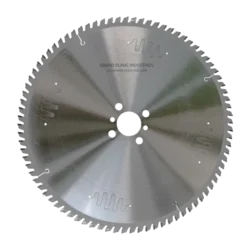
What Are You Cutting? (For 350mm (approx. 14″) Blades)
Not all mild steel jobs are the same. Choose the right saw blade based on the part shape, wall thickness, and the finish you need. Our 350mm (approx. 14″) carbide dry cutting blades are available in two tooth-counts — 80 Teeth and 100 teeth — each optimized for different cutting applications.
Quick guide: pick 80 Tooth for faster stock removal on thicker sections, 100 Tooth when finish matters.
| Tooth Count | Best For | Examples | Notes |
| 80 Teeth | Smoother cuts on heavier wall tubing & solids | – 3″ square tube – Angle iron & flat bar – Up to 3/8″ wall |
Lower chip load per tooth allows higher feed — practical: start at a medium feed and increase until you see consistent, smooth chips; finish will be slightly rougher than 100 Tooth. |
| 100 Teeth | Faster cutting on thin to medium-wall tubing | – 1″–2″ square tube – EMT conduit – .065″–.125″ wall |
Higher tooth count gives a cleaner edge but needs a slightly slower feed — practical: reduce feed 10–20% vs 80 Tooth for best finish; ideal when cuts go straight to welding or assembly. |
When to use 80 Tooth: Choose 80 Tooth for heavy wall tubing, thick flat bar, and when you need faster throughput and acceptable finish (good for structural work).
When to use 100 Tooth: Choose 100 Tooth when cut finish matters — trim parts, thin tubing, conduit, or when you want minimal secondary grinding.
Micro example: Cutting a 1″ square tube (0.125″ wall) with a 350mm (approx. 14″) 80 Tooth blade at a medium feed will be faster; switch to 100 Tooth and reduce feed by ~15% for a cleaner edge with less burr — adjust feed until chips look consistent. (Always confirm RPM and feed with your saw and material.)
What Makes These Blades Different
Carbide tip dry cutting blades are engineered specifically for metal cutting saws to deliver a different set of tradeoffs than abrasive wheels or general-purpose saw blades. They remove material with discrete carbide teeth, so they cut cooler, more accurately, and with far less dust and sparks than abrasive methods.
Key Benefits
- Cuts Cooler
- Cuts Faster
- Lasts Longer (typically)
- Cuts Accurately
- Safer Operation
- Lower Maintenance
- More Cost-Effective
Higher upfront cost is offset by fewer replacements, faster cycle times, and reduced secondary finishing — lowering cost per cut in production environments.
Benefit → Practical impact
| Cuts Cooler | Less discoloration — often no need for post‑cut grinding near the weld area. |
| Cuts Faster | Higher throughput on structural steel and tubular work. |
| Lasts Longer | Lower $/cut and fewer blade changes per shift. |
Note on claims: if you include a numeric lifespan claim (for example, “up to 20x”), add the test conditions or link to the test report in product or technical pages to maintain transparency.
Blade Life & Maintenance Tips
- Run at the recommended RPM — why: keeps chip load and heat in range; how: confirm the saw nameplate and use 1,200–1,800 RPM for most 350mm (approx. 14″) carbide blades (300mm (approx. 12″) blades may run higher).
- Clean blades regularly — why: built-up material increases friction and heat; how: wipe with a soft brush and a mild degreaser after heavy use, avoid harsh acids that can harm carbide bonds.
- Don’t force the cut — why: forcing creates heat, dulls teeth, and shortens life; how: maintain steady feed, reduce feed on 100 Tooth for better finish, increase feed on 80 Tooth for throughput.
- Inspect before each shift — why: early detection prevents failures; how: look for missing carbide tips, excessive chipping, heat discoloration, or unusual vibration.
- Store properly — why: moisture and impact shorten blade life; how: keep blades in blade protectors, dry racks, or with a rust inhibitor, and avoid stacking loose blades together.
- Know end‑of‑life signs — why: prevents poor cuts and safety issues; how: replace when you see rounded teeth, persistent burning/discoloration, or excessive vibration.
- Use the right blade for the application — why: correct tooth count and geometry extend life; how: pick 80 Tooth for heavy sections and 100 Tooth for fine finish (also consider 40T/80T options where applicable).
Frequently Asked Questions
Can I use these blades on a woodworking saw?
No. These carbide tip blades are engineered for low‑RPM metal cutting saws only. Woodworking saws typically run between 3,000–5,000 RPM, which can overheat or damage a dry cutting blade and can create unsafe conditions. Always check the saw nameplate and manual before installing a blade.
What materials can I cut with these blades?
These blades are specifically engineered for mild steel and structural steel — tubing, angle iron, flat bar, and similar ferrous metals. For non‑ferrous metals (aluminum, brass) or stainless steel, use blades designed for those materials or consult our product pages for recommendations.
What blade sizes are available?
We offer 300mm (approx. 12″) and 350mm (approx. 14″) carbide tip saw blades. Typical maximum safe RPMs are listed on product pages and the blade nameplate — commonly, the 300mm (approx. 12″) blades are rated higher (up to ~2,000 RPM) and 350mm (approx. 14″) blades lower (up to ~1,800 RPM). Always verify the specific blade spec before use.
How long do these blades last?
Blade life varies with application, material, and technique. High‑quality carbide tips typically outlast abrasive wheels and lower‑tier blades substantially in comparable conditions. If you reference a numeric multiplier (for example, “up to 20x”), include the test method or link to the test report on the product or technical page to be transparent about conditions.
How do I know if my saw is compatible?
Check the saw’s nameplate or manual for RPM, blade diameter, and arbor size. Compatible saws typically fall within the 1,200–2,400 RPM range for the saw blade options shown above. If unsure, take a photo of the nameplate and contact support — we’ll confirm compatibility.
Do these blades leave a clean finish?
Yes. Carbide teeth shear metal cleanly, producing cooler cuts with less burr and discoloration than abrasive wheels. In many cases, parts come off the cutting saw ready for welding or assembly without secondary grinding or sanding.
Can these blades be sharpened?
Technically, yes, but it’s generally not recommended for these precision carbide tips. Sharpening requires restoring tight tangential and radial tooth angles; if done incorrectly, it reduces side clearance, increases friction and heat, and can significantly shorten blade life. For most shops, replacing the blade is more cost‑effective than regrinding. See our maintenance page for sharpening guidance and recommended vendors.