
Knowing when to sharpen a cold saw blade is the single biggest factor separating a shop that gets 22,000 clean cuts out of a blade and one that’s burning through blades every few weeks. Most HSS circular cold saw blades start showing wear after just 800 to 1,000 cuts, and if that first sign gets ignored, the damage compounds fast.
Key Takeaways
- Watch for five physical signs: rounded teeth, rough cut edges, excessive feed pressure, unusual noise, and burr formation on the workpiece.
- Inspect every shift, not just when something feels wrong. A three-minute visual check catches dullness before it costs you thousands of cuts.
- HSS blades can be resharpened 20 to 40 times, with a median around 22 cycles based on our internal log of over 50,000 processed blades. Read the full breakdown on how many times you can resharpen a cold saw blade.
- Carbide-tipped blades typically handle 8 to 15 resharpenings before the carbide is ground past the brazing line.
- Sharpening almost always beats replacing. See the math in our sharpening vs. replacing cold saw blade ROI breakdown.
- Cold saw blade sharpening costs $15 to $23 per blade scaled by diameter, a fraction of what a new blade runs. Full pricing is on our cold saw blade sharpening page.
- DIY sharpening usually shortens blade life instead of extending it. Professional CNC sharpening preserves temper and tooth geometry in ways a bench grinder cannot.
What Are the Signs It’s Time to Sharpen Your Cold Saw Blade?
Cold saw blade store customers ask us this question every single day, and the answer is almost always visible before it’s audible.
Dull teeth don’t fail quietly. They telegraph the problem through the cut itself, the feed pressure, and the sound of the machine.
The Blade Requires Excessive Pressure
If your operator is leaning harder on the feed than usual to get through the same material, that’s the blade telling you it’s done cutting efficiently.
Excessive pressure also accelerates tooth chipping, which shortens the number of resharpening cycles left in the blade.
The Blade Teeth Look Rounded
A sharp cold saw blade has crisp, defined cutting edges on every tooth. Once those edges round over under magnification or even a careful eye, the blade has already lost a measurable percentage of its cutting efficiency.
The Cut Edges Appear Rough
Clean cuts come from sharp teeth shearing metal cleanly. Rough, torn, or burred edges on your finished parts are a direct symptom of a blade overdue for sharpening.
The Saw Operates Louder Than Usual
A dull blade fights the material instead of slicing through it, and that fight shows up as noise, vibration, and heat. If your saw sounds different than it did last week, don’t wait for the teeth to chip before sending it in.
We cover each of these symptoms in detail on our guide on when a cold saw blade needs sharpening, including brand-specific tolerances.
This infographic outlines five signs that indicate a cold saw blade needs sharpening. Learn how timely sharpening preserves cut accuracy and blade life.
How Often Should You Inspect a Cold Saw Blade?
Inspection cadence should scale with how aggressive your material is, but the baseline we recommend is a per-shift check, not a per-week check.
Waiting for a full week to check the blade means you could push thousands of cuts through a saw that’s already rounding over.
Our own intake data shows that five symptoms account for most dull-blade pulls, and all five are catchable in a three-minute routine performed at the start or end of a shift.
Shops that skip this step tend to wait until teeth are already chipping before pulling the blade, which is the number one reason blade lifespans come in under expectations. Full detail on the cold saw blade inspection routine is available on our site.
When Does a Cold Saw Blade Actually Need Sharpening?
There’s a difference between “the blade could use sharpening eventually” and “the blade needs sharpening right now.” Knowing when to sharpen a cold saw blade means reading the combination of signs, not just one isolated symptom.
A single rough cut edge might be a material issue. Rounded teeth plus rising feed pressure plus louder-than-normal operation together mean the blade is past due.
Prompt sharpening at the first combination of these signs extends total blade life and reduces unplanned downtime. Waiting until the blade is visibly struggling costs you more cuts than it saves.
How Many Times Can You Resharpen a Cold Saw Blade Before Retiring It?
This is one of the most common questions we get, right behind “when to sharpen.” The textbook answer for HSS blades is 20 to 40 sharpenings, but our internal log across more than 50,000 processed blades shows a median closer to 22 cycles with an upper tail for well-maintained blades.
Carbide-tipped blades don’t get quite as many cycles. They typically resharpen 8 to 15 times before the carbide is ground past the brazing line, at which point sharpening is no longer possible.

Blades ground on CBN wheels, which remove only 0.8 to 1.2mm per cycle compared to 1 to 2mm on aluminum-oxide wheels, gain 25 to 40% more lifetime cycles overall. That’s a direct result of tighter, less-aggressive material removal per pass.
Retirement criteria are specific, and one of them is non-negotiable: four or more broken teeth means the blade body itself is fatigued and should come out of service immediately, regardless of how many resharpening cycles are left on paper.
| Blade Type | Typical Resharpen Ceiling | Key Retirement Trigger |
|---|---|---|
| HSS Cold Saw Blade | 20-40 cycles (median ~22) | Diameter shrinks below minimum, blade body fatigue |
| Carbide-Tipped Blade | 8-15 cycles | Carbide ground past brazing line |
Track your resharpen count. Shops that don’t track it lose an average of 3 to 5 cycles per blade to premature replacement, and blades run until teeth chip lose about 31 percent of their total lifetime cycles compared to blades pulled at the first sign of a burr.
Sharpening vs. Replacing: When Does the Math Favor Sharpening?
Sharpening vs. replacing a cold saw blade isn’t really an opinion question. It’s a math problem, and in nearly every scenario we’ve run, sharpening wins by a wide margin.
Here’s a worked example straight from our data. An initial HSS blade costs $400. Running it through 22 sharpening cycles at roughly $19 each adds up to $418 in total sharpening spend, bringing total tooling cost to $818 across the blade’s full life.
Compare that to a replace-only approach pushing the same 22,000 cuts through new blades at $10,000. That works out to a cost per cut of $0.037 for the sharpen-first approach versus $0.45 for replace-only, a difference that shows up directly on your bottom line every single shift.
Cold saw blade sharpening is the difference between spending $930 and spending $10,000 to push the same 22,000 cuts through your shop.
Break-even is typically reached after a single sharpening cycle. Once you’re past that point, every additional cycle is nearly pure savings compared to buying new.
Full worked numbers, including how to calculate your own cost per cut, are on our sharpening vs. replacing cold saw blade page.
What Does Cold Saw Blade Sharpening Cost in 2026?
Cold saw blade sharpening costs $15 to $23 per blade at Grand Blanc Industries, scaled by diameter. Replacement, by contrast, can run hundreds of dollars per blade depending on size and tooth configuration.
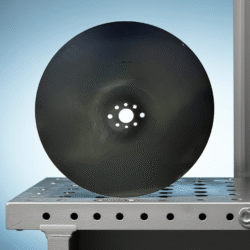
- 8″-12″ blades: $17.00
- 13″-14″ blades: $19.00
- 15″-16″ blades: $21.00
- 17″-18″ blades: $23.00
- 19″-20″ blades: $25.00
Blades arriving with excessive dullness, chipped teeth, or cutdowns are billed at double the normal sharpening charge, so pulling a blade at the first sign of wear rather than waiting saves money on top of saving cutting time.
New blade pricing runs alongside sharpening pricing on the same page. A 315mm 2.5mm 32mm M2 HSS Saw Blade runs $138.97 new, and a 350mm 2.5mm 32mm M2 HSS Cold Saw Blade runs $159.04. Both are priced under our Best Prices Guaranteed policy, and we match or beat competitor prices online.
Why You Shouldn’t Sharpen Your Own Cold Saw Blades
We get asked constantly whether a shop can just sharpen its own blades on a bench grinder to save time. The short answer: don’t, and here’s why.
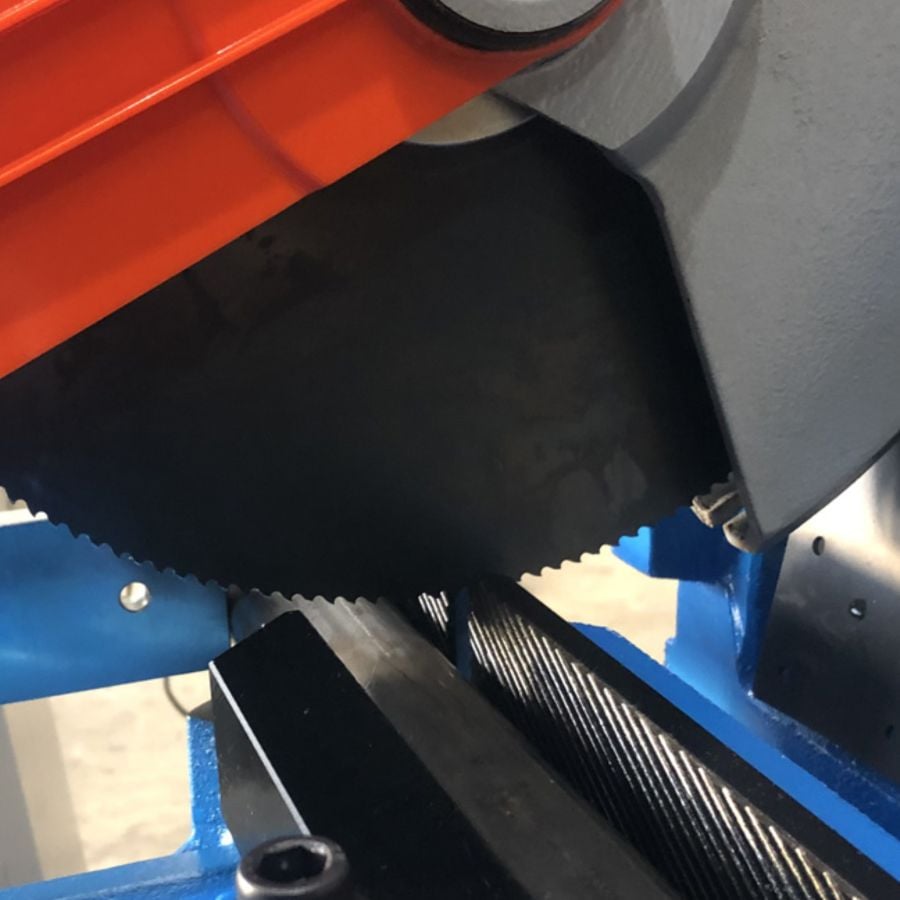
DIY sharpening can reduce accuracy and shorten blade life if it’s done improperly, and improper is easy to fall into without CNC equipment. Uneven grinding pressure alone can throw off tooth geometry enough to cause chatter, poor finish, and premature failure.
Our staff has over 80 years of combined experience and is a top HSS blade shop for a reason. Professional sharpening uses CNC grinders, laser measurement, and ultra-fine diamond grit wheels to preserve tooth geometry to tolerances a hand-fed bench grinder simply cannot match.
The overall blade finish is maximized due to the high pressure coolant used during grinding cycles, which in turn prevents warping or tempering of the blade. That’s a problem common on CNC machines that utilize vitrified grinding wheels instead of our approach, and it’s one of the reasons blades sharpened in-house at your shop tend to have shorter usable lives than professionally resharpened cold saw blades.
How Cold Saw Blade Store Sharpens Your Blades
Cold Saw Blade Store is the number one choice for saw blades and cold saw blade sharpening, and the equipment behind that claim is what makes the difference.
With over 2 million dollars in saw service equipment, we’re able to offer same-day turnaround on all of your sharpening needs. Grand Blanc Industries operates over 8,000 square feet of CNC sharpening equipment, making us the largest CNC sharpening company in the country.
No one has the amount of CNC sharpening equipment under one roof that Grand Blanc Industries has in the US, or the world for that matter.
Carbide-tipped saw blade sharpening uses diamond wheels to retain tooth geometry, running 15 to 20 cycles per blade in high-volume shops. HSS and steel saw blade sharpening uses CNC grinders with minimal material removal per pass to preserve temper and hold the tightest geometric accuracy possible.
Need help choosing the right cold saw blade for your application, or figuring out proper RPM and cutting speeds for your material? Our Cold Saw Blade Guide covers tooth configurations, speed and feed charts, and chip formation so you can dial in cuts correctly between sharpenings.

For many machines, RPM is limited to two settings, high and low. It’s necessary to compromise and select the speed that best applies to the material. Too low a speed is always better than too high a speed, since running too hot accelerates tooth dulling and shortens the interval before the blade needs sharpening again.
Cold Saw Blade Maintenance Tips to Extend Time Between Sharpenings
How long should a cold saw blade last? A correctly used blade lasts 24,000 to 40,000 total cuts depending on material and maintenance, but that number depends entirely on habits between sharpenings.
- Break in new and resharpened blades gradually instead of running full feed rates immediately.
- Keep coolant flowing consistently; dry spots cause localized heat that dulls teeth faster than normal wear.
- Store blades flat and protected between uses so teeth aren’t nicked in transit or on a cluttered bench.
- Match RPM and feed to the material using proper cutting speeds rather than running one setting for every job.
- Track resharpen counts per blade so you know when a blade is approaching its ceiling instead of guessing.
Using a semi-auto or fully-automatic cold saw instead of manual feed can extend blade life by roughly 30 percent, since consistent feed pressure reduces the chipping and gouging that comes from inconsistent hand-fed cuts.
Two practical takeaways sum up the whole maintenance picture: inspect every shift, and don’t wait for teeth to chip before sending the blade out. Our full cold saw blade maintenance guide covers break-in, lubrication, sharpening intervals, and storage in more depth.
Shop Cold Saw Blades and Sharpening Services
If your blade is already showing the signs above, don’t fret! Sending it in for a professional sharpening is faster and cheaper than most shops expect, and it’s making blades feel brand new instead of running them until failure.
Cold Saw Blade Blades Since 1984, we’ve built our reputation on same-day turnaround, Best Prices Guaranteed, and keeping blades in top shape cycle after cycle. Browse our full shop for new blades in a range of diameters, including the 315mm 2.5mm 32mm M2 HSS Saw Blade and the 450mm 3mm 50mm M2 HSS Saw Blade.
Wrapping Up
Knowing when to sharpen a cold saw blade comes down to reading the signs early: rounded teeth, rough cut edges, rising feed pressure, and a louder-than-usual saw. Catching those signs during a per-shift inspection, rather than waiting for chipped teeth, protects both blade life and cut quality.
The math consistently favors sharpening over replacing, with cost per cut dropping by more than tenfold in our own worked examples. Whether you’re tracking resharpen cycles on an HSS blade or deciding when a carbide-tipped blade has reached its limit, cold saw blade sharpening remains the cheaper, faster path compared to buying new every time.
Cold saw blade sharpening services have been proven to increase the life of your blade and improve cutting performance, and our team is ready to help you decide exactly when to sharpen a cold saw blade for your specific setup.
When to Sharpen a Cold Saw Blade Frequently Asked Questions
How do I know when to sharpen a cold saw blade?
Look for rounded teeth, rough cut edges, excessive feed pressure, and a louder-than-normal saw. If two or more of these signs show up together, it’s time to sharpen the cold saw blade rather than push it further.
How many cuts does a cold saw blade last before it needs sharpening?
Most circular cold saw blades handle 800 to 1,000 cuts before the first sharpening is needed, though this varies with material hardness and machine feed rate. A correctly maintained blade can reach 24,000 to 40,000 total cuts across its full resharpened life.
Is it worth sharpening a cold saw blade instead of replacing it in 2026?
Yes, in nearly every case. Our cost-per-cut data shows sharpening runs around $0.037 per cut versus $0.45 per cut for replace-only, making sharpening the clear financial winner.
How many times can a cold saw blade be resharpened?
HSS blades typically handle 20 to 40 sharpenings with a median around 22 cycles, while carbide-tipped blades handle 8 to 15 cycles before the carbide is ground past the brazing line.
Can I sharpen my own cold saw blade at home?
We don’t recommend it. DIY sharpening on a bench grinder often reduces tooth accuracy and shortens blade life compared to professional CNC sharpening with laser measurement and diamond grit wheels.
How much does cold saw blade sharpening cost?
Pricing scales by diameter, starting at $17.00 for 8″-12″ blades and rising to $25.00 for 19″-20″ blades. Blades with excessive dullness or chipped teeth are billed at double the standard rate.
What happens if I wait too long to sharpen a cold saw blade?
Waiting until teeth chip rather than sharpening at the first sign of a burr reduces total lifetime cycles by roughly 31 percent. It also increases the risk of retiring the blade entirely if four or more teeth break.
